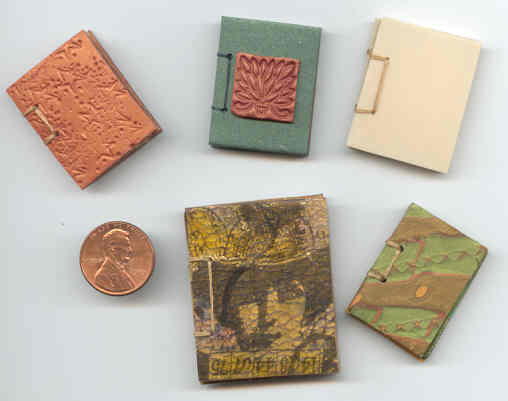
Minibooks
...some examples-websites
....pages
....binding
& construction
.......various, fanfold, other types
....hinges
for minibooks
....more info + misc.
.......notepad
covers + Post-It covers
Covers ...notebook,
journal, other
(Bookmarks)
MINIBOOKS & BOOK COVERS & Bookmarks
more ideas and inspiration for making book pages, covers, etc. in Cards
General info ...lesssons... examples... ideas
There are many ways
to make mini-books from polymer clay, or from polymer and other media...
and many ways to bind them.
The following are mostly very
small "mini-books" (often used as pendants or pins)
-- but also include larger small books made with clay
some EXAMPLES ... more below
Painted Puddy's minibook swap
http://www.claycat.faithweb.com/book.htm
(click on each to see hinges, pages, etc.)
Robin
Beaty's many mini-books
http://www.pcpolyzine.com/july2001/mafa.html
*M.Briggs' minibooks,
etc.
http://members.aol.com/polyopoly/misc.htm
... http://members.aol.com/polyopoly/bandw.htm (b&w
)
Gerri's amulet
necklace mini-books (spine is at top, steno-style... clay tubes & wire...see
more in Pendants>Hinges)
http://www.newfry.com/Jewelry.htm
(gone)
Sexton's
minibooks, hinged with twine and two holes
http://www.mhpcg.org/images/members/sextonKaren/books.jpg
Lynelle’s little,
tied, books
http://members.aol.com/lynellev/cgallery.htm#Books
Nora Jean's
tiny mini book & lesson (keep clicking and
read book's pages for lessons)
http://www.geocities.com/Area51/Shadowlands/2708/bookproj.html
Beckah's Coptic bound mini-books with transfers,
leafing, powders, stamping.
http://www.bearingbeads.com/Images/_ishrinebooks.jpg
Klew:
beaut.necklace & ivory book
http://klewexpressions.com/klew/oneofakind.html
Robin
Beaty's transfers are sometimes "hidden" beneath a hinged cover ...some
do resemble small books
http://www.pcpolyzine.com/july2001/mafa.html
winners
of Amaco's "Itty Bitty Book" Designer Challenge
http://www.amaco.com/html/chawinners.html
Sue
V's tiny booklet (pins?) with clay plaque decoration (website
gone)
Bev's
Mr. Potato Head book (cover is Mr.PH shape with onlaid features) http://www.yeoldouthouse.
http://isisesc.supelec.fr/gallery-nenuphar/PolymerClay/aas (prob.
gone)
Kathy G's Egyptian theme book cover (sort of ivory, stamped &
antiqued) (website gone)
Cathy’s book pin http://www.nwpcg.org/claycamp1999.shtml (gone)
Pat
Baldwin's various kinds of minibooks, some polymer http://www.primenet.com/~patbooks
(gone)
Yang Yang's miniature books http://www.myart.com/yayaju/FrameSet1.html
(gone)
nenuphar's many minibooks for swap, using triple layer shapes (top
one is colored transfer)...2 have faux rivets, tied with ribbon (hinges inside?)
Michelle's minibook
swap http://www.cde.com/~lunytune/Swap.htm
(gone)
Michelle’s
lesson for a minibook http://www.cde.com/~lunytune/minihow.htm
(gone)
canejane's vairous mini books and notebook covers ...http://www.picturetrail.com
(gone)
"Books" or mini-books can be made from any relatively flat, joined items as the pages....
papers...
fabric... metal, or just anything that one can think of
....I
saw some made from shrink plastic... made as spiral bound books.
My guess is that we can do the same thing with polymer clay.
....here
is one mini-book made from empty photographic slides
http://www.canadascrapbooks.com/photopost/showphoto.php?photo=3537&papass=&sort=1&thecat=500
...(each
slide "page" here is covered with decorative paper, then a small
photo or print is sandwiched inside the "frame," but clay-wise
we could cover them with clay ...don't know if the plastic ones could be
baked with the clay though... or we could use sheets of clay as the focal
images, or use transfers (decal-types might be cool), etc.
...I
sewed my pages to felt cut to the size of the covers (i think it's called
saddle stitching) with enough space between the covers to close the book
and glue the cover to the outside of the felt. Lois H
Patricia
Kimle’s larger pages have bas relief polymer figures and items ...placed
on top of fabric or drawn-on fabric as backgrounds (?)...as pages in an
alphabet book for her grandson
http://www.kimledesigns.com/animalbook/animalbook.htm
I
decided to type the inside text (my handwriting is atrocious!) on
paper... I'm using Word and Arial font (it's nice and plain, so still
easy to read in small sizes), 9 pitch (8 or 10 would also be good, depending on
how much text you wanted to fit on a page).
.... I had the best luck setting
it up as a table - 6 cells across and 4 down on a 8.5 by 11" paper in the
Landscape position.
....After typing in the text in each cell across, I just
copied it to the cells below, allowing me to get 4 sets of pages on each page.
....One note: be SURE to set the border to "None", unless you want a border
on each page.
....reduced my clip art items when photocopying &
have cut and paste them into the book's pages. (I tried scanning them & then
inserting them as photos in Word, but I had to reduce the images too much &
they became unrecognizable.) Lynne
baked
liquid clay can make very thin, flexible, sturdy
pages for a polymer book
... using plain liquid clay of most
brands will give a frosty translucent page unless opaque color
is added to change it (using a bit of titanium white oil paint, e.g.)... or
the original version of Liquid Sculpey (not TLS) is white after
baking
... the pages can be created with images on them (if
they are transfers)
...or without images, to be drawn on
or embellished later
Cindy P's lesson on making pages
from liquid clay and transfer paper
http://pcpolyzine.com/april2001/booklace.html
Sarajane's mini-lesson on making a minibook with Fimo liquid
clay pages (each page made from baked sheets with transfers made with
Epson Glossy Photo paper, then placed on either side of a thin sheet of white
clay with a light sponging of liquid clay... page edges gilded with variegated
gold leaf... her book also had a dimensional pig head on the cover
http://www.polyclay.com/pigbook.htm
...fabric
can also be embedded with liquid clay and act as pages
...I've spread
liquid clay on glass and baked it. It peels right off. (and if you pat a sheet
of metal leaf on top, the leaf doesn't need glazing, it sticks just fine.
You can then use a paper punch to make shapes)... for embellishment?
(for
loads of info on making liquid clay transfers, see Transfers
> Liquid Clay ... and embedding fabric in Mixing
Media > Fabric)
baked thin regular clay
can make thin flexible and study pages too,
but thicker than liquid clay
...the pages will be the same color as the
clay used, including translucent
.....could even be fauxs, like
stone, gold, marble, etc.
...they can also be created with images by
using a transfer technique
...or without images, to be decorated later
...I
took a class from Kathy Amt at Arrowmont (she is also a book maker)
......she
talked about making polymer paper with clay ...it's very flexible, and
seems to work fine.
......we
rolled to #5 or #6 on our pasta machines, baked them, and used it like
that.
..... we used Fimo Art Translucent, added inclusions, stamps,
transfers etc.
..... I don't know about other clays though, as I have
not tried them. Jenny P
...The new Bead and Button has an excellent article
on the polymer "book" design of Kathy Amt (it is meant to hang as a fan-shaped
pendant
. . . the "pages" are clay (backed temporarily?) on tracing
paper (while) passed through a pasta machine at # 6
....collages
or sheets of cane slices, stampings, etc.
...... Violette's small book
of larger fancy and embellished polymer sheets . . cover
is all polymer too. . . cool!
http://www.picturetrail.com/gallery/view?p=999&gid=1340337&uid=477851
........also
her Box-Book . . .a clay box with sheets of embellished polymer stacked
loosely inside
http://creaplastic.free.fr/10vio_06.htm
........Linda
Goff's Polymer Postcards http://www.lindagoff.com/postcards.html
...Premo is really flexible when very thin.... you can also brush
a sheet of it with liquid clay to make it stronger still without
losing any flexibility. Irene NC
...Sculpey would
not be a good choice though, because it's not flexible when thin and would crack
or chip.
how thin
one can get a clay sheet that will bend completely without breaking
or tearing?…
...if baked correctly, most clays except Sculpey
will be strong and flexible... baking longer than the normal 20 minutes
may increase strength of most clays even more.
...I made some pages by running
Fimo through my Atlas on a paper backing at the "6" setting (8 is the thinnest,
1 the thickest).
...Then I baked it on the paper, and rubbed the paper off
under water.( If the paper has lines on it,
they will transfer).
....You can use those fancy deckle scissors to
cut the edges the way you want them after it's baked and it looks sharp.
...
I tried baking the pages already folded (the
paper was "tented" up), but the mini book cracked at the
fold pretty quickly (I had stitched it with sewing thread and had beads
on the outside of the seam)
... I'll have to stack and stitch them
next time.
....The cover was also baked folded, but I think
because it was a skosh thicker (base is setting 4 with an additional front and
back overpanel), it is holding up better. Donna in Dallas
Several
ways to prevent curling
of thin flat clay when baking.
...One is to place something heavy on top of the piece while baking.
...However,
if the weight will harm the surface technique, then wait until the pieces comes
out of the oven and while it is still somewhat hot, place heavy books on top of
it until cool....Or, while it is still hot but not so much so that you can't handle
it, fill the sink with cold water and then lay the piece down on the bottom
of the sink and hold it flat until it is cool. Dotty in CA
more on BINDING & CONSTRUCTION possibilities
see
below in Notebooks, for more ways of using holes
and various cords, disks, etc, as binding
At first I thought I would make beads to use as closures for the pages,
but a cover would be even better.
.......I was planning to make holes in the
covers before baking and then binding the entire book together with heavy waxed
thread, eliminating the need for adhesives.
Crafty
Owl's lesson on making a scrapbook-type book with clay cover
(two hinged parts on top), (clear) sticky-back plastic, and embroidery
thread or ribbon.
http://www.polymerclaycentral.com/owlnotebook.html
I actually bound the pages with linen thread, following instructions in a fantastic book about making books, called Cover to Cover.... I then glued the first and last pages to the inside front and back covers (using Sobo, I *think*), and glued a marbled endpaper on top of each of them....Jalina's mini book swap -
…I used ??? (like for a 3-ring binder) to attach them so I could keep adding pages like a notebook. Kathy
CraftLace is a flat plastic lacing that is like the stuff we made lariats with in scout camp. . . . "made in USA of 100% PVC." . . . Since this is a flat strand it seems a bit heavy or coarse for loops but may work well to connect sections of pc, perhaps as part of a book binding.
I have come up with a few, and so far the one i like best is a mini passport book. Inside I could have on a small sheet of paper my name, email address, and phone number. The promblem is...how do you go about holding a book together...it would need to be relativly small, and able to hold real paper inside so I could put the info in it.
lesson on using cut CD's as minibook covers,
with ribbon or cording dangles (bead on end) to close ... these
are pendants
http://www.creative-cards.co.uk/newsletter/trish/cdbooks/cdbookclass.html
Gerri's
larger books with various spine techniques
... and also mixed media
and stamping, transfers, etc.for fronts, (see second book pg.also)
http://www.newfry.com (see also her blog,
but many photos now gone)
Dar's various minibooks or covers
http://www.afamilyjournal.com/artzz_and_i.htm
...Dar's
several hinged (book-type) blade holders, long
and slender ...she uses "silk" adhesive tape (as an outer spine,
overlapping front and back) to connect and hinge the parts (which accepts paint
then Future well)
http://www.afamilyjournal.com/pctools3.jpg
Dayle's minibook pins
... some are just 2
sheets of decorated or embellished clay, held together with ties
on one corner or on one or both sides (one has two "doors" as a front
cover which only partially obscure the interior, and open to each side)... heavily
embellished
http://dayledoroshow.com/pics1.htm
Juliann's
lesson on using Xyron (laminator?? --but not necessary, especially for
smaller books; could use other glue or spray adhesive) to add a decorative cover
to heavy weight cardstock; the "bottom" piece is folded ~one
quarter then becomes part of the front. Another sheet is glued behind that
(all the way to the spine) and the decorative paper (or baked clay sheet?) is
attached to the 3/4 front cover part, then trimmed.
http://www.odd-goddess.com/html/xyron.html
esp. accordion-folded (fan-fold)... with various embellishments
Nanetta's
lesson at sculpey.com on making a small accordion folded-page mini-book
.........with an image stamped on translucent, framed (Shapelet) with
a cover made with chopped clays
...pages are stamped,
sponged, colored pencils, etc.
http://sculpey.com/Projects/projects_AsianProverbBook.htm
Cindy
P's lesson on making a fanfold (accordion) mini-book....
with ribbon and clay binding
http://pcpolyzine.com/march2001/polybook.html
Barbara McGuire's lesson on making a fanfold
mini book (using mulberry paper 18" long) with 1/8", 2 1/4" square,
clay covers, and button and loop closure; she also shows how to make a
gold imprint with a stamp and gold leaf
http://www.hgtv.com/hgtv/cr_paper_crafts_books/article/0,,HGTV_3288_1387419,00.html
Shala's lesson on making a
fanfold mini-book and cover (pgs are held in cover "pockets"),
plus some printable pages/covers
http://shala.addr.com/magazines/index.htm
http://shala.addr.com/print/minis/index.html
simplymad's lesson on making a fanfold
book with polymer cover
http://home.earthlink.net/~simplymad/html/notebook.html
fanfold pages
which also attach to two covers lesson (from Home Matters TV
show, Jan 28, 01).
....Happened upon this show and liked this idea for making
a little book using an easy-to-fold method. The guest created a unit of
3-fanfold-page-flaps, then attached the last two single flaps around the front
of the covers (like a visible binding). As near as I can tell, this would be the
way to do it (this always yields 3 page flaps plus two end flaps --if you want
more than 3 pages for your book, make multiples of these units and glue them together):
1. make two covers (for example, 4" wide by 3" tall)
2. decide on
a width for the page holder flaps (they'll extend into the inside of the book,
and the pages will be pasted onto them), let's say 1" (or Z)
-- multiply your Z by 10 (1"x 10 = 10"); that will be the length of
your unit
--for the width, use the same measurement as the length of the spine
area (3" in our example)
--(cut a piece of paper 3" by 10"
--she used black construction paper)
3. carefully lining up the edges, fold
the unit in half widthwise
--as you would create a fan, fold back one end
edge back to the folded middle; turn unit over and fold the other one back too
--now fold the edge again back to the twice folded end; turn unit over and repeat
--(this is the nifty trick:) to make the remaining 2 folds, open the unit
up and fold each end to the indention of the 2nd fold at the opposite end --you'll
see which one when you try it; (turn over and repeat)
4. glue each of the
single flaps at the end to the *outside* of your cover (creating the look of a
binding), or I suppose the flaps could be glued to the insides to hide them
5. wrap a decorative cord from inside the front cover next to the "spine,"
around the outside of the back cover, and then tie a secure knot at the bottom
of the spine area; add more decorative cords/threads, beads, or whatever, and
tie the cord ends again to hold the additional decorations.
6. glue pages
of your choice to the front of each interior flap
To make many pages from one 8 1/2 X 11" in sheet of paper... first fold it in fourths (fold in half one way then fold each half in half) ...then turn and do it the other way.... Next cut three squares in from one direction, three squares in from the other direction, then back to the other side.... Then fold back on each other. (It may be easier to follow if you just try it.) wannabe
other
I just spent an hour in the rubber stamping store in the mall, and came out loaded with beautiful new papers - vellum, mulberry, embossed card stock... now I'm looking forward to making not only the little presentation boxes, but tiny little books. There was a woman on Carol Duvall a few weeks ago who made the most beautiful little tiny books (Janet someone?) entirely without glue or any binding other than the folds in the paper. Elizabeth
Anima
Design's lesson on an interconnected "Library Pocket"
& flap book (not polymer, but adaptable with cardstock or heavy paper
and small sheets of polymer glued on pages)
http://www.animadesigns.com/librarypocketbook/stepbystep.htm
Anima Design's many other kinds of small,
handmade book styles (concertina, tassel book, cyanotype, flag book, carousel,
metal flange binding, sushi mat cover, coasterbook, runic, abecediary )
http://www.animadesigns.com/artistsbooks/artistsbooks.html
Juliann's
openable "fan" books (covers of polymer, pages of paper)
--wide blade shapes, hinged at bottom with tassels/cording, which open
like a fan
http://www.odd-goddess.com/html/fan.htm
"Mini Books and Boxes"
book by Design Originals... the cover shows many kinds of mini-books
(made of paper, etc., but could be polymer)
http://www.catladycrafts.com/MiniBooksBoxes.html
http://www.d-originals.com/paper.html
Clay
'Memory Book' cover. . . "Creating With Polymer Clay" by Steven Ford &
Leslie Dierks, on page 96-97 you will find some basic techniques that should answer
most of your questions. though they are pretty vague instructions. . .
"Cover
to Cover" is a good general book on bookbinding/making. . . . by Shereen
LaPlantz is a good bookbinding book. Its about 145 pages, and costs about 25 bucks.
*
Violette's small samples book of fancy and embellished polymer sheets,
cover is all polymer too. . .& "box-book"...cool! ... all kinds
of collage
http://www.picturetrail.com/gallery/view?p=999&gid=1340337&uid=477851
http://creaplastic.free.fr/10vio_06.htm
...coffee filters
(cone ones) used for the pages. . . This isnt the page I was talking about..but
might help some http://netnet.net/~cloud9/
(look under Tips)Jan
....The coffee filter
books/cards consist of a cardstock cover (which when fully opened resembles
a butterfly shape) into which coffee filters (the cone-shaped with the point cut
off kind, not the Mr. Coffee kind) have been sewn or otherwise bound. You can
design your own cover template by laying two filters back to back (cut-off point
side to cut-off point side) on a piece of paper and tracing around adding one-fourth
inch, or so, all the way around. Now fold this in half (left to right) and match
up the edges, trimming where necessary. The kind I have seen and made are bound
on the closed side of the filters leaving the open-ended filters as the pocket
pages into which you can place confetti, a tea bag, a little note, a small baggie
of ep, flat candy, or whatever . . . . The filterscome in several sizes, in white
and in kraft brown, and are very inexpensive
Hi! I wrote the instructions. . . The
coffee filter will be open after they are bound. The "pages" are seperate little
cardstock pages which go inside the filter "pouches". You can put anything you
want inside the "pouches". I have a friend who made hers into a "coffee book".
Inside each "pouch" was a little fact about coffee. artbyamy
make
tiny collages of magazine pictures or something, if you don't feel
artistic
...rubber stamps (esp. from angel companies, copyright free)
or clip art are other ways to go.
...for multiple copies, you
can make ONE original, then photocopy the others you need, if you want to go that
way – you could get several
narrow strips for accordion fold type books on one copy, if you planned it
right.
I used the transfer method to place pictures of dinosaurs
in the book (being read by a dinosaur). Karen
(scrapbooking)
...baked Premo and Sculpey III (and maybe all polymer clays) are "acid
free (neutral pH) and lignin free” so they should be fine to
use in fine scrapbooking, etc. if properly and completely cured.
. . the sculpey.com website says . . ."“Polyform’s chemists
have been conducting tests on the clay for quite some time. All tests indicate
that . . .
http://www.sculpey.com/Scrapbook101.htm
...does
anyone know about these though, acid-freewise?? --Sculpey --SuperSculpey --Fimo
--Kato Polyclay --Cernit
--and liquid clays from all 3 manufacturers????
.....liquid clay transfers of all kinds would certainly be cool in scrapbooks
if so, and thin too. Diane B.
...I
suppose we could get some pH strips and do some testing ourselves on those.
I have a pond and have to get some anyway to test the water.... so the acid-free
property is still in question. . . . However, I think we can safely say all
those are lignin-free because they are not made from plant materials
. . herbalmama
...Dimples' lesson on making scrapbook page decorations
with sheets of clay and bas relief embellishments
http://www.sculpey.com/Projects/projects_Scrapbook_1stMemory.htm
For the hinge side of the book you can use small metal hinges,
or glue in a piece or leather or ribbon for the spine, attaching the front
to the back in this way. You can fanfold a strip of paper and glue it in
for the pages. LynnDel
...see above and below also for other ways of attaching
We make covers from two pieces of polymer clay (front cover and back) up
to maybe 2.5-3 inches square and glue small metal hinges between them,
with a long strip of pretty accordion folded paper between... These can
be blank books or you can laser print, rubber stamp, or hand decorate the pages.
...
As for covering existing books, I think what I would do is bake the polymer book
cover separately then glue it on. You might kind of mold the clay to go over the
edges of the cover, for neatness.
...(OR make books the entire size of
the hinge --DB)
Durapore
Bandaging Tape... Someone mentioned this is good (as hinges) for use
with clay-covered books
(you can find it at) At a pharmacy -type of store
...in the first aid area where they have other bandages and tapes. Patti
for cardboard/papier mache, packing tape (brown, on a roll) works wonders as a bond or as hinges...I use it for armatures along with cardstock. Sarajane H
Lee Valley Hardware (metal
hinges)
http://www.leevalley.com/hardware/index.asp?category=3&SID=&ccurrency=2
Buesseler hinges, graduated beads
http://www.drizzle.com/~nwpcg/lastmonth.shtml
(gone)
Sunni’s small wire-twisted
mini-hinge lesson (like the eye half of a hook-and-eye notion, with
a coiled middle)
http://sunnisan.com/crafts/hinge1.html
Robin Beaty's mini-books and pendants with hinges
http://www.pcpolyzine.com/july2001/mafa.html
Dayle's "openable
book" pins?... decorated front and back (no pages) hinged in two places
with simple wrapped cording in holes
http://albums.photo.epson.com/j/ViewPhoto?u=1751472&a=32123747&p=73924301
Gerri's books with various spine techniques (see second book pg.also)
http://www.newfry.com/books.html
and http://www.newfry.com/artists%20books.htm
Crafty
Owl's lesson on making a scrapbook-type book with clay cover
(two hinged parts for top cover), (clear) sticky-back plastic,
and embroidery thread or ribbon.
http://www.polymerclaycentral.com/owlnotebook.html
Tory (Victoria) Hughes
has a video (Hinges in Polymer Clay) now on three ways to
make hinges: to hinge on the side of a pendant or frame, or to hinge
two parts of a pendant together, or to actually hinge
within, a pendant creating a swinging part :
she mainly uses the
"door hinge" type of hinge, in which a pin of some kind is run through
tubes of clay which are attached to each side (usually two tubes on one
side, one on the other side) ... she creates the hinge tubes in place for an exact
fit.
http://www.polkadotcreations.com/books/videos2.html
(near bottom of page)
....
for more info on hinges and types,
see Pendants-Cording
> Hinges & Lockets & pivots hinges
.... Frames
> Tri-Fold Panels ....Vessels
> Hinges
(mailing list) group for makers of small books http://groups.yahoo.com/group/books_and_boxes
Turtle
Press' list of good books to read on making books, scrapbooks, etc.
http://www.turtlearts.com/bookshlf.html
Sunni's collected info on creating
handmade papers
http://sunnisan.com/ppr/papermaking01.html
Sunni's
collected links on papermaking and bookbinding
http://sunnisan.com/ppr/paperlinks.html
Templates
by Donovan (templates for accordion books and others, plus mucho other stuff)
http://www.bydonovan.com/templates.html
printable color book covers (for transfers?)
http://www.geocities.com/Heartland/Meadows/1832/printables/books.htm
Jim's "printables" -- Jim has scaled-down
versions of many kinds of things that may be useful in reproducing minibooks (can
be printed and transferred onto clay, or simply printed on paper)
http://www.printmini.com/printables/
printable,
leather-bound books and book covers
http://miniature.net/smallstuff/gallery6.htm
http://www.printmini.com/printables/
(click around)
cool flap-over boxes ... Marlies' covers box and cardboard
for rigid cover with contact paper, but it could be clay? (see details in Boxes-Gift)
http://www.mcuniverse.com/Video_Tape_Covers_-_Recycled.700.0.html
Michelle R's lesson on making a mini-box/book
http://www.hgtv.com/hgtv/cr_paper_crafts_boxes/article/0,1789,HGTV_3289_1396620,00.html
for
clay covers
...canework ...faux leather or faux
ivory
....I have been
thinking about using Granitex for a cover material.... I found some
papers which also have that granite/speckled look to use as matching
pages.
(for more cover ideas, see just below in Notebooks
& Covers)
notepad covers... Post-It covers
notepad covers . . . make a sheet
of clay the same width as, but 1 1/2" longer than the pad you
want to make a cover for... place the pad face down onto the clay with the extra
clay extending out past the glued end of the pad... fold the clay extension up
and then over the front of the pad ...remove pad, prop cover while baking,
then re-glue to pad (perhaps adding a bit of metal sheeting or something
else on the underside of the clay where it overlaps the top of the pad might make
it even stiffer when tearing off each sheet?)
http://www.paperzone.com/cornereveryday8.htm
(example using cardboard or cardstock as cover)
note pad on a neck chain with a tiny pencil that slides through two tubes on one side to hold it closed. It isn't that different from a mini book.
lessons on making your own notepads ...with
inexpensive padding compound or white glue in Misc
> Notepads . . .also info on some interesting things to use for pages and ways
to use the pads
Post-It
pad covers & notebooks... various polymer covers can be
made for the sticky back notes or for the loose papers (or you could cut your
own papers)......these could be made in the same way with all polymer,
or using cardboard, etc. and decorative paper, contact paper, etc.:
...most
of the lessons on making these don't refer to how the Post It pad is actually
attached to the back cover... I did find one reference to "double-sided
tape like Tombow Monoadhesive Permanent Tape" in the supplies, but didn't
indicate how it was used)... pads of paper usually have a stiff back cover which
can be slipped into a pockets or under a strip, etc. to hold them in place, but
Post Its have only a piece of ordinary paper temporariily stuck to the
back
.......a raised frame can be built onto the interior of
the back cover which holds the pad in a kind of shallow well http://www.stampactelpaso.com/giftideas/ij086.jpg
.......a pencil or pen holder can be created with a polymer
strip-loop on the interior of the spine area (or a ribbon or other material
glued down except for a raised loop area)
..simple fold-over template
http://www.victorineoriginals.com/freepage1.html
..example
with 3 loops for closure and also to hold pen (like hinge (2 loops on one
cover, 1 on other)
http://www.stampactelpaso.com/giftideas/ij077.jpg
lessons:
http://www.odd-goddess.com/html/postitbks.htm
and http://crafts.dm.net/mall/classes/981121.html
(2) 3 1/2" squares (back and front)... (1) 3 1/2 x 1/4" spine... 4 1/2 x 2" (large
thin "hinge", applied on front overlapped to back)... 3 1/2 x 2" (second
hinge piece..apply to inner side over spine and covering ovelaps from first hinge)
. . . .lay down the first spine piece, face down... put the two covers onto the
spine, leaving a gap between them (this will be spine area) ...fold spine over
to inside...lay 2nd spine piece over the gap face up
....open- box type
holders can also be made for Post It sheets or pads ... cover a free standing
open box of approx. the correct size, or make a free standing one to fit the sheets
(or cut your own sheets, or use sheets from gummed pads) ... remember to leave
a slot opening on the front to grab the sheet
.......RuthAnn
says this match box cover is exactly the right size to fit the smallest size
pad of Post-It notes (2 x 1.5 inches), so instead of making
the box bottom, just slip a package of notes inside the decorated
top.
http://www.ruthannzaroff.com/mirkwooddesigns/matchbox.htm
..Gerry's
3 post it covers http://www.newfry.com/books.htm
..........
I would recommend using cardstock or even a little heavier weight paper
so the form will hold up to the clay. Lisa D. ....(for making or covering matchboxes,
see Covering > Paper)
COVERS... Notebook + Journal + other
Various
types of books (hardbacks, photo albums, journals, diaries, sketch books,
etc.) and notebooks (spiral-bound or taped spines, for example)
can have their
front and/or their back covers "covered" with polymer
clay (along with embellishments, patterning, etc, if desired)
......those with
blank covers are good, but pre-printed covers can be hidden by the
clay if its' used on the whole surface..
...or the covers themselves can be
made from clay only
SOME
SOURCES for blank books:
inexpensive
blank books that could be covered with polymer clay are sold at barebooks.com.
Rae
http://www.barebooks.com
I scoped out the quality of the ones in the local art store, then ordered
'em a little less expensively from Dick Blick catalog
http://www.dickblick.com
IreneNC
I purchase mine from the Borders Outlet stores (remainder
books outlet of Borders Books & Music)... theirs are acid free paper,
with various dark colored covers. I pay $4 or less for them
The
coverings or the all-clay covers can be made separately and baked,
then glued on.....or raw clay can be baked onto some covers directly.
...Use
something very flat and large enough to create and bake the covers you want (either
something slick like glass or tile, or put a sheet of paper between)
...If
you want to cover the whole front with a prebaked clay cover, create
it on a sheet of paper with the proper size drawn on it, or just measure the base
clay sheet
....... or use a sheet of glass over the cover or over the template,
or use a sheet of plastic wrap instead (see Paints
> Polymer Paintings for some examples)
...be aware though that there
can be some shrinkage in length with some clays
when using larger sheets of clay, so for
large covers you may want to make them a little too large then cut off the excess
after baking while the clay is warm, or just allow the clay to be a bit smaller
than the original cover.
I make the
clay (base) for the front on a # 3 setting, place it on a stiff mat board
or on a paper-covered tile, and finish decorating it so I won't have to disturb
or distort anything before baking
...Once the raw clay is decorated
and I cut holes in it to fit my journal, I bake the clay for longer
than recommended to insure durability. (I usually have the clay at a #3 setting,
but no thinner and I use Premo clay.)
...assembly is easy. ... slide the
new clay cover over the wires in the same way the cover was taken off. Patty B
(thinking
of a wire coil here?... if so, put the end of the coil into the
top hole, then rotate it as it goes through all the holes)
for making
holes in baked clay covers, covers, and paper, etc., one possibility
is a Japanese screw punch (or "Japanese book drill ")
...a rotating punch, with various interchangeable bits.... when
pressed down, the handle causes the shaft to turn the drill bit (which is actually
a hollow punch), creating a smooth hole
...create holes anywhere,
in stacks of paper, cardstock for making books, or in baked clay, leather,
mat board,etc.,
...smallest bits are good for waxed threads ...larger
bits for book posts, leather cord, etc.
http://www.pcpolyzine.com/2004february/bookdrill.html
...(for other hollow punch-out tools, and push drills which
will also create holes, see Cutters
> Punches & Hand drills)
You can also make a series of holes
in baked clay covers with a comb binding machine (like one of Ibico's
http://images.google.com/images?sourceid=navclient&ie=UTF-8&rls=GGLC,GGLC:1969-53,GGLC:en&q=Ibico+
)
since the clay cover won't be too thick (most small machines can handle
up to 25 pieces of paper with one cut)...don't know if they'd do this at
Kinko's, etc., or not, but they could do the pages... many schools also have these
machines
...then use a plastic or wire "coil"-comb to slip
the covers and pages into if the book isn't too thick for the machine you're using
(otherwise, have Kinko's do that part)
Rollabind system
for holding pages and covers . . . similar to coiled wire, but are individual
(thin, lipped) disks each of which slips into one of the T-shaped holes,
allowing the pages to be removed and reinserted ... will open 360 degrees
http://www.polymerclayexpress.com/rollabind.html
http://www.rollabind.com/HowItWorks.html
http://www.scrapbooking.ca/rollabind.htm
...Rollabind
Tote Notebooks ...with 60 sheets lined paper 6 3/4" X 7"- $6.00,
and 8 1/2 x 8" . . . at PolymerClayExpress
Plastic and wire
binding pieces can be inserted through rectangular holes created in the edge
of paper and cover with a binder
(see more in Websites below for ways
to make coils and other attachers at the spine)
Here's
what I noticed in my own experimentation while making notebooks. I've used Premo
& Fimo Classic. The only softener I've used is a little mixquick in some of the
older Fimo.
...when doing larger books, my experience has been that the
Premo shrinks more than
some other brands... the per-made holes then wouldn't line up with Premo's holes
(made when raw).
..on smaller notebooks it wasn't a problem
...Fimo
worked okay on the larger ones though, even though it has a bit of shrinkage
too, I could still line the holes up enough to use the covers. Joanie (note
that the newer formulations of Fimos, etc., may also shink more when large.
What
makes some kinds of paperboard (even heavier board) warp is applying something
(paint, glue) to one side.
....As long as you apply the same thing
on both sides, it will dry flat.
(necessary?) ...So if you want to cover
paper-based boards with raw clay, I would coat both sides with Sobo
(or another strong white glue) and apply a thin sheet of clay on both sides.
Perhaps the sheet on the inside could be the thinnest sheet possible.
....
or you might get away with putting clay on just the front if you coat the back
(inside cover) with Sobo. This might take some experimenting.
...I'd like to
try this, but don't know how to do it....I'm concerned about the cardboard
cover warping
...I have found that different
book bindings can be a problem, especially the ones that are glued. Now you are
going to have to peel it off and re-glue after baking...so why not just bake
the sheets alone and glue them on afterwards?
I use a
texture sheet and PearlEx on the inside of the clay cover...
and stamp my initials and year on the inside
...my covers may have transferred
images from either Lazertran Silk or Prismacolor pencils used on a black toner
ink copy
...I made one photo album using texture sheets that had a theme...
deer tracks and a deer ("North American Animal" and "Animal Tracks")
on clay which I made to look like leather......I'd use the "Animal Skins" rubbing
plate for the inside of the cover now.
...I used leather lacing to hold it
closed. Patty B.
I
make clay tiles and mount them on the front of journals for a
double deck effect (or triple layer, using framing paper layer etc).
....I
use plain white Sculpey-in-the-box which is not very strong, but when mounted
on something else it's as strong as it needs to be for this.
....
Cre*it!'s textured, white-Sculpey-in-the-box clay tiles, folded
double thickness after one pass through pasta machine, which are mounted
on ceramic tiles, on notebooks, cards, vessels, even jewelry, giving
them sufficient strength and retaining lightness
(then finished with their special tinted glazes),
http://www.dotcalmvillage.net/cre8it/polyglaze.html
http://www.dotcalmvillage.net/cre8it/polyglazetech.html
(lessons to come)
lesson
(on clay-only covers?)
...what I like to do is cut the covers off
of a hardback book (front and back), then make my own covers with sheets of polymer,
(which are then) connected with a piece of natural muslin glued an inch
apart-or whatever thickness the book is, plus allow for the thickness of the sheet
of clay x 2.
...then glue the muslin to the bindings with rubber cement or
book-binding glue (PVA ..or strong "white glue)
...also, when gluing,
incorporate a sheet of paper from the front of the book itself and the
back and join this to the polymer sheet! Whala!!
On occasion I have
created journals from scratch where I provided the interior pages myself
...I
have used various ways to assemble them....I'm not into fancy sewing or
other ways of attaching covers, but there are several good books available to
learn how.
Kathleen Amt must have started making books the regular way before she got into the polyclay ones. She has a regular book in "Cover To Cover" that has a couple of polymer fish dangling from a closure tie.
EXAMPLES & more LESSONS:
Lisa
Pavelka's lesson on
making a shaped mosaic, which is then glued to the front of a book,
etc., after baking
http://www.hgtv.com/hgtv/cr_clay_other/article/0,,HGTV_3239_1396715,00.html
.....and Lisa's book with a large
(non-mosaic) clay plaque glued to the front
http://scratchart.com/gallery/gallery2.html
Sue's
lesson on making a torn-edge slab with onlays from molds,
stampings, stones. encircled with clay, and Pearl Ex to
glue onto a cover
http://www.mystyfae.com/book.htm
COVERS
Mia's lesson on covering a notebook
http://www.clayfulmingles.com/notebooklesson.html
Cindy P's lesson
on making wire coils for mini-book
http://pcpolyzine.com/april2001/booklace.html
*Patti's lesson on covering a notebook, & covering
the spiral
http://polymerclayhaven.com/lessons/balance.htm
Crafty Michele's
lesson on notebook cover with replaceable small notepad
http://www.polymerclaycentral.com/r_notepadcover.html
*Jan’s lesson for notebook covers
http://people.delphi.com/janruh/clay/notebooks.htm
(gone?)
Irene's journal covers (wire bound)
http://www.good-night-irene.com/journals.html
Tonja's many
beautiful journal covers using component pieces added to base fronts
(stamped and powdered, etc.)
http://www.tonjastreasures.com/journals/journals.html
many
beautiful mixed media journal covers, often with transfers,
layering, collage
http://www.art-e-zine.co.uk/pcj.html
and http://www.art-e-zine.co.uk/playwithclay.html
Gerri
Newfry's many journal covers with various spine techniques,
mixed media and stamping, transfers, etc.for fronts
http://www.newfry.com/newfry.com%20iweb%2006/gallery.html
http://flickr.com/photos/gnewfry/sets/1285439
(2 pgs) ..... http://newfry.typepad.com
sinilga's
puzzle-pieces of textured clay with onlays and a photo (liquid
clay on front, as well as back), glued to the front of a photo album (details
in Sheets of Pattern > Pieced)
http://www.craftster.org/forum/index.php?topic=235709.msg2581183#msg2581183
Arizona
guild's notebook swap (mostly spiral covers)
http://home.att.net/~reserved/Notebookswap.htm
canejane's several notebook covers
http://www.picturetrail.com/gallery/view?p=999&gid=683097&uid=502621
Terry's chrysanthemum
cane notebook cover
http://www.cerridwencreations.com/art/xmas%20gifts/notebook.JPG
lesson on placing transfers on
cards & scrapbooks, etc., surrounded by frames
http://www.michaels.com/art/online/projectsheet?pid=23046
Mia's
many notebook covers & matching pens
http://www.clayfulmingles.com/notebooksandpens.html
Heather R's notebook covers & matching
pens
http://members.home.com/claythings/pens3.htm
Nancy (&Tanya?) notebook covers & matching pens http://albums.photo.epson.com/j/AlbumIndex?u=1751472&a=13568584&f=0
Nancy' small covered notebooks with matching pens (website
gone)
Sally's
cover-the-wire-spiral notebook cover (website
gone)
Meredith’s cover http://www.nwpcg.org/nov99.shtml
(no longer available?)
Elisabeth’s
notebook covers (website gone)
see Cards > Bookmarks for all info on making various types of bookmarks
(for bookends, see Sculpting > Bases and Settings.... and/or see Gifts)
(see
also: Carving
for book ideas )
(see
also Cards
for more decorating ideas for flat sheets)