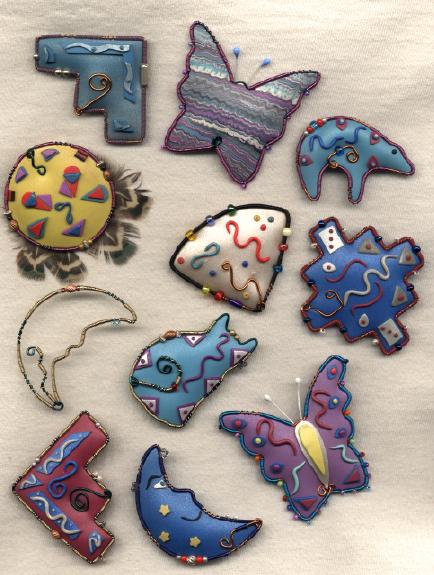
Gen. info (re wirework)
....basic
wire shapes
Types of wires
...plastic-coated
..telephone wire, etc. (metal core)
...other
metal-core wire
...all-metal wire
.....colored
metal
Coils..Spirals...Twists ...mesh
... hinges
Tools ...pliers,hammers,cutters,other
...Jigs
More
info re handling wire
Uses & ideas
for wire
... figures, jewelry, memo holders, attachers, adhesive for,
etc.
....wrapping
+ frame-outlines
....cells
Books, videos, Online groups, etc.
Other
Websites
....also, my Wire
Play class notes: http://www.glassattic.com/polymer/wireclass.htm
WIRE
see
the Jewelry page
and the
Pendants-Cording page for suppliers, and much more info
on findings, etc
see also the Wire
Play page which contains my notes and lessons for a
wire class I gave to kids-beginners
http://www.glassattic.com/polymer/wireclass.htm
all kinds of wire http://www.parawire.com/
Connie Fox's lessons, basic wire info
(Single Eye Pins,
Double Eye Pins, Wrapped Eye Pins, Eye Pin Variations, Jump Rings, Jump Ring Variations,
Spirals, Simple Clasp, "S" Clasp, Coils)
http://www.conniefox.com/WireSkills/Basic%20Wire%20Skills.htm
and loads of other wire info (Work Surface, Lighting, The Wire,
Wire Cutters, Pliers, Wire Wrapping Jig, Hammers, Saw Filing, Bead Reaming, Measurement
Mystery Tool, Drawplate and Punch Bead Compartments, Designing Wire Jewelry, Antique
and Polish, Digital Photography of Jewelry, Wire to Web)
http://www.conniefox.com
WigJig University's many simple illustrations and lessons
on working with wire
http://www.jewelry-tools.com/WJU/techniques/index.html
(click on all 6 pages)
various beading techniques
http://www.wigjig.com/jewelry-tools/WJU/jewelry/jewelrybyG/beginners/index.html
http://jewelrymaking.about.com
Preston
Reuther's site (most selling his "system" for learning wirework):
http://wire-sculpture.com/patterns.php
(many lessons, download with Acrobat Reader)
http://wire-sculpture.com
(home page)
Connie's page for many types of tools used
in wirework (definitions, info, etc.)
http://www.jatayu.com/Supplies/Tools.htm
...also
suggestions for basic tools (and also next-level)
tools needed for doing wirework (...she suggests very good quality names for every
tool, but buying that level of quality for each tool isn't necessary unless
you want to do a lot of wirework, and make high-end jewelry from more expensive
wire, etc.)
http://www.jatayu.com/Education/StudioTour/ST-ToolList.htm
online
video lessons re various techniques for wire and jewelry making (which
may include basic techniques)
http://www.firemountaingems.com/pbs/default.asp?kwsearch=pbsseries1
and in Jewelry
> Connectors
(...loops,
eye pins, head pins, clasps, spirals, coils,
etc....)
jump rings can
be purchased in many sizes, colors, and even several shapes, but you can
also make your own
. . . (lessons): wind the wire
around a dowel, and it should be wound so tight that there are no spaces between
the rings
...from there, you can cut each individual loop of the coil
with wire cutters
...OR to cut all the loops at the same time...bring
the wire down to the end of the dowel (or remove it and hold it in your fingers),
brace it against a wood cutting surface, hold the dowel and wire firmly while
using a jeweler's saw (with a bit of beeswax on it?) at a 45 degree
angle. As you cut the jump rings will either fall off the cutting blade or onto
it
...http://www.conniefox.com/Education/WireSkills/JumpRings.htm.
. .
....lesson on coiling and cutting your own jump rings (coiling
instructions are more precise than most people might need) at about.com Jewelrymaking
http://jewelrymaking.about.com/library/weekly/aa092898.htm
http://jewelrymaking.about.com/library/weekly/aa012701.htm
(fancier)
…often purchased machine-cut jump rings (and
jump rings which you make yourself and cut with wire cutters) don't
have a totally flat cut edge, so they never do close entirely
... but you can file the ends to make them flat and smooth (or use a jeweler's
saw to make them)
...jump ring variations ...hammered, twisted
wire, and double (jump rings)
http://www.conniefox.com/Education/WireSkills/JumpRingVariations.htm
ALSO
chain maille techniques (many many patterns using many
jump rings joined together)
http://www.dcwireworks.com/howto/howto.html
(2nd half of page)
.....many photos and links
re chain maille jewelry http://tinyurl.com/bzmyq
....Wigjig's
lesson on making a box chain (aka square or Queen's chain) with
jumprings
http://www.jewelry-tools.com/WJU/techniques/chains/pg11.htm
making head pins from plain wire
(hammer end to
create a "paddle" pin, then file any roughness
....or bend over
one end with round nose pliers and close tightly, below tip)
http://www.beadandbutton.com/bnb/default.aspx?c=a&id=285
simple
loops .... most often used as end loops, or for making an
"eye" pin
...the
basic loop is the foundation of most jewelry making... it's pretty simple
once you get the idea, then you can make loads of jewelry
...loops
are often made at the end of a length of wire (or at the end of
an eye pin or a head pin) --though they can be made in
the middle too
...you'll need a pair of "round
nose" pliers (also called "rosary" pliers), since regular flat
nose needlenose pliers just won't work well
LESSONS:
http://www.artbeads.com/howtomasilol.html
http://www.beadaroo.com/techniques/view/wireloop?ps_session=ac88e36ed1eda82e4a65dace5fc2490a
simple
loop (not re-centered) ...basics lesson
http://www.jewelry-tools.com/WJU/techniques/loops/basic.htm
...problem
solving your loops, if necessary
http://www.beadaroo.com/techniques/view/wireloop_soln?ps_session=ac88e36ed1eda82e4a65dace5fc2490a
http://www.beadworksboston.com/tips-techs/pdfs/simple-loop-tech.pdf
(loop next to bead)
http://www.conniefox.com/Education/WireSkills/DoubleEyePins.htm
(loop next to bead at each end)
http://www.jatayu.com/Education/WireSkills/EyePinVariations.htm
(double loop at each end of bead)
(double loops can also
be used to hold things http://www.nanosite.com/confab/c-impulse.htm
)
http://www.beadandbutton.com/bnb/default.aspx?c=a&id=34
(they make a bend first, then make the loop)
http://www.jewelry-tools.com/WJU/techniques/loops/eye1.htm
http://www.conniefox.com/Education/WireSkills/SingleEyePins.htm
(she makes the loop first, then straightens the neck)
"neckwear"
for eye pins (a tube or coil)... plus hammered eye on eye
pin
http://www.conniefox.com/Education/WireSkills/DoubleEyePins.htm
Desiree's lesson on making a simple loop in the middle of a wire length by holding the wire at its midpoint with round pliers, then crossing each end of wire to the opposite side (for creating a top loop in a wire frame around a pendant)
http://www.desiredcreations.com/howTo_PJBrassFramePendant.htm (step 1, part 1)
"wrapped"
loops
http://www.jewelry-tools.com/WJU/techniques/loops/wrap1.htm
http://www.beadaroo.com/techniques/view.php?technique=wirewraploop&ps_session=ac88e36ed1eda82e4a65dace5fc2490a
*about.com's
lesson on making a (single or) doubled-ended wrapped loop which
can have a bead in-between, for a "chain" of beads
http://jewelrymaking.about.com/library/weekly/aa092198.htm
wrapped
loop with diamond shape below (for green earrings)
http://p097.ezboard.com/fturtlebayjewelryforumsfrm7.showMessage?topicID=21.topic
(middle of page)
(for making spirals --- see below in Coils,
Spirals, Twists)
CLASPS:
"U"
hooks (...hook at one end, loop at the other end):
lesson
on complete simple clasp (both parts)...single-wire U hook+loop,
plus lessson on figure-8 shape as other part of total clasp)
http://jewelrymaking.about.com/library/weekly/aa080398.htm
Corgi's lesson on making a hook+loop, with perpendicular
loops... plus lessson on figure-8)
http://www.polymerclaycentral.com/hookeye.html
Connie's lesson on making a hook+loop with perpendicular
loop (with thick wire), for a clasp end (top part here is also hammered) http://www.conniefox.com/Education/WireSkills/SimpleClasp.htm
lesson on making a single wire hook+loop (loop "stop")
at end, and wrapped loop
http://jewelrymaking.about.com/od/wirejewelryfindings/ss/041107.htm
lesson on making a doubled-wire hook+loop (though they can be
different shapes and sizes than this!)
http://jewelrymaking.about.com/library/weekly/aa041299.htm
"S" hooks (hook at both ends)
lesson
on making a (fat) S-hook for a clasp
http://jewelrymaking.allinfoabout.com/features/handclasp.html
Eni's lesson on making an S-hook for a clasp, and also "wrapping"
a doubled-back cording with thin wire to create a loop for jump
ring
http://www.enioken.com/jewelry/012leather.pdf
Connie's lesson on making an S-hook for a clasp (14-16 g wire)
(hammered)
http://www.conniefox.com/Education/WireSkills/SClasp.htm
photo of S-hook to attach to loop on either side (click on Fig. E)
http://www.hgtv.com/hgtv/cr_accessories_jewelry/article/0,1789,HGTV_3225_3108675,00.html
lesson on 2 basic wire hooks (photos
prob.gone tho)
http://www.cs.hmc.edu/~cweisige/hooks.html
Connie's swan clasp (with spiral)
http://www.lapidaryjournal.com/stepbystep/apr03bangle.cfm
"toggle" wire clasp, with figure 8 with one loop larger
into which the toggle fits
http://jewelrymaking.about.com/library/weekly/aa09220a.htm
lesson creating "spacer
bars" using a length of wire made into coils in several places
http://www.beadaroo.com/projects/wirework/001.php?ps_session=ac88e36ed1eda82e4a65dace5fc2490a
http://www.beadaroo.com/projects/wirework/001c.php?ps_session=ac88e36ed1eda82e4a65dace5fc2490a
ear wires
...there are several types, esp.
the French type (aka "fishhook") which pass through the ear hole but don't
clasp, and the kidney type (which actually close under the ear
for more security)
(.....purchased French earwires generally
look like this:
http://jewelrymaking.about.com/od/finishingtechniques/ss/080905_2.htm
)
MAKE YOUR OWN:
simple French earwire
http://jewelrymaking.about.com/library/weekly/aa021603.htm
adding a bead to simple French earwire
http://jewelrymaking.about.com/library/weekly/aa022303.htm
"wrapped French hook" ...but don't put the final
loop at the last... just bend the end out slightly like regular French
ear wires
http://jewelrymaking.about.com/library/weekly/aa080299.htm
(click on pg. 2 also)
round and
square ear wires (made on a WigJig, but not nec.)... they also hammer the
shapes
http://www.wigjig.com/pages/pdf/easyearwiresBW.pdf
weird looking ear wire, made with "decorative" headpin
http://www.diynetwork.com/diy/cr_jewelry/article/0,2025,DIY_13762_3520387,00.html
(click Fig. D)
...Klew often uses a metal
"charm" finding between the earwire and earring to give extra
design and interest
http://www.klewexpressions.com/jewelry/earrings.htm
..."gypsy" ear wires, with multiple loops at bottom for hanging dangles
http://jewelrymaking.about.com/library/weekly/aa052301.htm
...various types of dangle earrings
... some instruction http://www.artbeads.com/earrings.html
(click on each for more)
...earrings in the fancy galleries these days seem to have ear
wires that are integral to the earring rather than a loop and
hook effect... one way to do that would be to use oversize kidney wire
ear findings... straighten out the safety hook part (kinda twist it to the
side and straighten it, and bend it around til you are happy)...then sandwich
that part in between layers of clay....leaving the long oversize wire part
to come out as a massive earwire... works nice. ....or maybe put one between the
two halves of a lentil bead before you put it together (may have to put
some clay inside and bake the wire into that) Emma
....plastic earwires are very inexpensive, and many
people can wear them if allergic to metal wires ...they come in
various colors (including black and white) and can also be dyed. ....they
are more durable than they at first appear to be ….I wouldn't use them on intricate,
expensive earrings, but they can be very effective on the simple, less expensive
designs....the colored wires provide an interesting effect with polymer clay dangles.
..."stops" for the back of
earrings... my mother came up with the idea of using a plastic margarine lid ...
punching disks out of it with a hole punch... then poking a hole through the center
for earring stays....(a really cheap method to keep from losing an earring...
I put them on all my earrings now). Linda H.
...for purchased metal hoop
earrings ... after slipping your bead(s) onto the hoop, bend the free end up just
a bit to allow it to slip into the metal hole at the other end
http://www.artbeads.com/howtofianden.html
"wire wrapping"...
wrapping stones or other objects with wire in various ways to encapsulate them,
plus adding a loop/etc. for hanging as pendant
(see more below in Ideas
for Wire)
Micki’s lesson on doing a simple wrap/holder/top loop
for a flat oval stone (or whatever)
http://www.geocities.com/mick62001/simplecabwrap.html
Cris's
many fancier wire wraps and embellishments, on pendants
http://endlesswire.com/dichroic.html
Eni's
many lessons on various wire wraps and embellishments (most $5
each,downloadable)
http://www.enioken.com/jewelry/lessons.html
NixCreations'
many fancy wire-wrapped pendants
http://createapendant.com/dichroic.htm
(...also click on other pages under the category "Wrap It Up")
Eni's
lesson on making "herringbone" weave to capture
a round bead with wire, with fancy weave at top and bottom
http://www.enioken.com/jewelry/005herringbone.pdf
...NixCreation's
"Indian wrap" weave (same as herringbone just above) around
flat round bead (rounded edges)... sells DVD
http://createapendant.com/pictures/wwcb60.jpg
more
tips on wire wrapping http://www.everything2.com/index.pl?node_id=946529
(see more lessons below, especially under Coils, Spirals etc.)
Plastic-Coated
wire (w/ metal core)
... telephone wire, Twisteez, etc.
The telephone wire most of us use is 25-pair
centrex
.. inside the outer gray plastic sleeve, you have 50
small, solid copper wires which are coated with PVC. The clay bonds
to that very nicely and the coating behaves in the oven just like the clay does.
.......some thicker, phone wires often
have a different coating that doesn't stick to the clay.Halla
..."25
pair" wire is the right stuff (for bonding with the clay). It has 26
gauge copper wire with a pvc coating.
(smaller
pairings often are not copper --copper will
bend and keep its shape), and are most often 24 gauge which makes
bigger holes in the clay.
....There is one major advantage to some of the
smaller pvc coated 24 gauge pairings though...you can get solid color
without stripes, etc.
....The very best kind of telephone wire seems to
be the red, yellow, black, etc., ones (bundled together inside a the gray
plastic sleeve) that comes generally from older structures, so if you see someone
renovating, check out the telephone wire that's being removed.
...Also check
out your local wire or industrial supplier.
...I never
thought of approaching an electrician. They always have tons of scrap
wire too!
Fun Wire (by Amaco) ...it's
plastic coating is thicker than on telephone wire
...comes in 18, 22, & 24
gauge
...PVC-coated, copper (or silver) wire (underneath) in 18 solid colors:
........light pink,.red,,orange,,lavender,,purple,,yellow,,light & dark blue,
turquoise, mint green, green, black and white (more?)
...can be cut
with scissors or nail clippers
...can be purchased locally at Hobby Lobby
and Wal-Mart..& maybe other craft places
ONLINE: http://www.polymerclayexpress.com/wire.html
http://www.amaco.com/grouphome1.php?catID=73&productId=355&GROUP_ID=9&CATEGORY_ID=73&TITLE_NAME=Fun%20WireTM
Twisteez
Wire ...pliable, plastic-coated, copper wire
....comes in more colors than telephone wire, but fewe than Fun Wire? (rainbow
colors, some are pastels)
....can be purchased at some craft stores,
or online
http://www.twisteez.com/index.html
Twister Fun Wire??...colored
wire (same as Twisteez?)
http://www.polymerclayexpress.com/wire.html
Most
plastic-covered wire actually bonds to the clay when baked
with it (it's chemically related)
....make sure that the ends
of the telephone wire are covered
because the plastic covering actually shinks a bit in the process (of baking).
Ohio
.....Although Pier (Voulkos) started using telephone wire in her jewelry
in 1984, it wasn't until 1989 that she discovered that it could be baked into
clay. "I first played with it as a child making bugs and jewelry. It was a common
recyclable material used in children's craft projects. It is a perfect compliment
to the colorful clay." Discovering the bonding properties opened up the world
of making jewelry for Pier. "I could now make earrings without having to glue
each and every wire into the clay."
wire loops and
U's ...used as hangers & connectors
..because it bonds
to clay during curing, clayers can make hangers and connectors of various types
with plastic-covered wire to use for pendants, ornaments,
dangles, etc,
.....insert both "feet" of an
upside-down U-shape wire into the clay... no glue nec. (see Pendants
> Top Loops for more)
.....or use it as a connector by inserting
one end into the clay, then making a loop in the projecting wire...
then wrapping the loose end around under the loop (for "wrapped loops,"
see Jewelry > Connectors)
Debbie
Anderson's tiny shoes attached to cording with wrapped-loop telephone wire
connectorsand connectors for dangles
...and her tiny purses
with double-wire handles
http://www.geocities.com/thousand_canes
(click on Polymer
Clay Art)
fancy polymer bugs,
many with telephone wire
..Joanie's swap http://www.pbase.com/joanie/bugz
(3 pages)
...Joyce
Fritz' bugs have tiny twisted wires for legs
http://www.handscapesgallery.com/jewelry/joyce_fritz.htm
frog with wire legs and feet http://www.woodenstonegallery.com/images/jewelry/JFSfrog1e.jpg
Marcia
Rocha's funny sculptures using clay & wire (animals, people, things)
http://www.funnysculptures.com/sculpture.html
PolymerPeg used small coils of
telephone wire as "tube" beads on a necklace
http://www.polymerpeg.com/moibus.htm
short
length of telephone wire added to back of clay cutout for added
strength
http://www.hgtv.com/hgtv/cr_clay_jewelry/article/0,1789,HGTV_3238_3335450,00.html
Sarajane
used white telephone wire for the strings on her clay banjo
http://www.polyclay.com/mosaics.htm
Tamila's
flowers and leaves on telephone wire stalks in "flower
pot" (with bunny) (gone)
LindaWTX's telephone
wire, coiled connectors (gone)
Emma's (Pier-type) wrapped attachments to necklace
(gone)
Jeanne R. used lengths of tel.
wire to create impressions for her faux brick wall
http://www.heartofclay.com/pc/tutorials.htm
lessons
& ideas from Twisteez
http://www.twisteez.com/lessons.html
(simple lesson using wire as spiky hair)
....other
ways to use colored plastic-covered wire with clay (or with other things)
for figures, etc.
http://www.twisteez.com/basics.html
.... http://www.twisteez.com/gallery.html
wire figures and "note holders" http://www.michaels.com/art/online/projectsheet?pid=20248
Klutz
Press has a book called Wire-O-Mania, by Haab and Torres,
with lots of ideas for making things with telephone type wire (not clay, but
inspirational) http://tinyurl.com/5m4d7
...Design Originals has a short book called "Down to the Wire"
with cute projects
...Barbara McGuire has a book "Wire in
Design: Modern Wire Art & Mixed Media" with some telephone wire
In
effect, I made my own custom colored "telephone" wire
by painting on (the telephone wire?) two coats of green tinted liquid clay
to see how delicate I could get... I baked between coats
.......You can paint
liquid clay over plain wire to make your own custom telephone wire but
it takes many thin coats to avoid drips. It probably would be too fragile a coating
on large gauge wire unless many coats were applied.
Jody
...I twisted two strands together and coated them with liquid
clay. It turned out to be very strong.
What's the wierdest thing
you've "wrapped"?
I've wrapped firepolished glass triangles
to painted metal discs with striped telephone wire. Very cool.
Telephone
wire can be used to weave baskets as well... polymer bits would adhere
to them
...or a large multi-loop bubble wand made with twisted
wires http://www.kid-at-art.com/htdoc/lesson50.html
Other
things that work and bond with the clay are those colored, plastic-covered
paper clips
...and also the S'ghetti round lacing for crafts that
can be bought at crafts stores (though there's no wire inside).
Other
metal core wire
colored (& clear)
check out your local industrial wire suppliers
(at the hardware store) go to where they have the house wire, the wire that is wrapped in plastic coating. They will have the cut ends right there, look to see if it contains what you want.
I saw a necklace that someone made using bright colored paper clips (some striped ones, black ones and bright gold ones as well) from Staples & Office Depot. Each wrapped chain segment (1 paper clip) began like a figure 8. The ends were then wrapped around the middle after being connected to another clip. The designer added fun things from the "chain" of wrapped paper clips. Cheryl T-W
Softflex
(jewelry quality) wire is made from very thin, marine quality, stainless steel
wires woven togehter and then nylon coated; flexible and knottable; 12
colors, 3 diameters; used primarily for cording (see Jewelry > )
http://www.softflextm.com/products.htm
and http://www.softflextm.com/soft_flex_wire.htm
"CHANGE IN TERMINOLOGY! Soft Flex long ago was coated in clear
nylon, then the color being called Clear or Clear Satin. For the last 14 month's
we have been processing the color "Silver" into the clear nylon resulting
in a very nice matte "Silver" finish, a more refined color. When we launched the
product line called Soft Touch we also used "Silver" in the nylon coating from
the very beginning. Please note from this point forward our color selection for
clear will no longer be used in our order processing. Please place
any future orders requesting the color "Silver". This is the very same product
with same strength, as you have been using for the past 14 month's!"
Soft
Touch jewelry-quality wire (available only in
Clear; same performance as Soft Flex Wire with 50% more supple drape)
http://www.softflextm.com/soft_touch_wire.htm
gold
and silver (& copper) "jewelry wire" can be purchased in
crafts stores, bead stores, and online... usually on a spool or in coils
...wires
available at craft stores don't have as much silver or gold in them as those which
can be purchased from Fire Mountain, etc. (except copper?)
......higher
end jewelry usually uses these higher quality wires for ear wires, and other
wires which will show
...these wires come in various thicknesses
jewelry wire can also be salvaged from metal findings like earring wires, clasps, jumprings, etc.
galvanized steel or copper wire from the
hardware store... packaged in a coil.
.... (for what type of thing?)
...I recommend 20 gauge wire if it is small, like mine; but 18 gauge
would be better for a bigger piece.
....copper wire is normally softer than
steel, so you might want to go with a thicker gauge for copper (wire gauge #s
increase as the diameter decreases, thus 28 gauge would be much thinner than 20
gauge). Barb
...You may want to try any company in your area who wharehouses
and distributes copper by the spool. They usually sell scrap and
smaller spools of lesser weight.
I used wire from the floral
dept. @ Michael's. It cost around $.99 for approx. 25 pre-cut 20" peices
(. It is not the prettiest wire, but it's fine for what I am using it for. It
is also packaged straightened, not coiled. So there is no need for straightening
the wire, which is a PITA. It can also be spray painted if you really want to
get fancy.
Memory Wire …permanently-coiled,
tough, wire in long coil
...comes in 4 diameters ..beads are usually
strung onto it
...used for making bracelets
or anklets or rings, necklace chokers, wine glass charms
......can
also make Christmas ornaments... decorative coils for placing around
candles/jars/cans... etc.
...to put "stops" at
ends of wire, can curl wire backward into loop
...Memory Wire is dfficult to cut,
and too tough for jewelry-type wire cutters... must use regular wire cutters or
other tools or even kid's Fiskars scissors, or bend back and forth to break (possibly
with heat), etc.
see much more on using Memory Wire in Jewelry
> Bracelets
http://tinyurl.com/2dmfvf
(lessons/photos at DIY on making bracelets, necklaces, etc.)
suppliers
:
...PolymerClayExpress (3 sizes) http://www.polymerclayexpress.com/wire.html
…TSI 1-800-426-9984 (they also also sell findings, stones, beads,
boxes, sterling & gold sheet & wire, tools, etc ; excellent service, really
nice people, don't need a resale number)
guitar
wire . . . I think the strings, cut in little pieces, would make funky
hair-do's on dolls too. Lots of uses! Geo
….Julia's guitar wire bracelets
(&Geo's --she will upload somewhere?)
The
"piano wire" as the hobby shops guys call it can be found in
those plane/car model building hobby shops. I think it's also called music
wire. Desiree
...The hardware store sells piano wire (same as
“steel music wire” at hobby shops?) in tons of different diameters and you can
cut it down to the length you find comfortable. A cut-off wheel on the Dremel
works great for this - just wear safety goggles. Jacqueline
….Do not try to cut
piano wire with diagonal
cutters;
it left a slight crimp in my DH's cutters (of course I didn't use mine, they are
smaller) Kat
Also, if you have access to any place that does welding, welding rod is good too. Jacqueline
metal allergy..."hypoallergenic"
(wire/metal) means it's less likely to cause allergy than "regular"
(metal), whatever that is, so it doesn't necessarily mean a whole lot. ...Allergies
to metals happen when some of the metal leeches from the earring post and reacts
with your ear. But niobium/titanium is not supposed to leech..... there
are plastic stud findings at Rings & Things, but there's the minimum order...
btw, in bulk, silver earwires are less than 50c apiece. ....of course,
there's the option of making your own earwires, which would be really cheap.
hello summer!
...hypoallergenic usually just means that there is no nickel
in them (what causes problems in most people). Some things labeled surgical
stainless steel are labled hypoallergenic even lots of them have
nickle ....so it really depends on how severe the allergy is. ... plastic earwires
are damn near impossible to find..... sterling silver is kind of expensive,
but worth it ... or a nice coat of clear nail polish keeps the itchies away for
a few months until it wears off and you have to reapply it. something weird
colored metal wire
the (metallic?) colored craft wires seem to be all pretty much the same thing: a copper wire core covered with a colorful coating. The color doesn't rub off, but it chips easily if you manipulate the wire too much or too forcefully with bare pliers. Wrap the jaws of your pliers with masking or painter's tape. Duct tape will also work. Any tape will tear where the wire rubs it, so you'll have to replace it frequently. Alice
Artistic
Wire jewelry-quality (permanently colored,
enamel-coated, copper or silver wire, resistant to scratching,
peeling, hammering, tarnishing, and marring; square or round;
...50+
colors... 14 gauges (10-24 ga)
...for wire wrapping and forming, and for use
with the jigs, Twist N’ Curls and Weaving Dollies
.....as well as the Wacketdown™,
Nylon Tipped Hammers, Anvils, and L & D Drawplates.
http://www.artisticwire.com
http://www.clayfactory.net/artisticwire/index.html
http:www.softflextm.com/artistic_wire.htm
...IMO there is pretty much no point in even considering using any of the artistic
coloured wires as use for ear-wires
...Even
if you could get the ends of Artistic Wire nice and smooth for going into the
ear, the coatings would come off, and they are not
made of nice metals to wear. Emma
niobium
(coated?) wire is a great metal for allergies too. Emma
...Even
if you could get the ends of Artistic Wire nice and smooth for going into the
ear, the coatings would come off, and they are not made of nice metals to wear.
Your best bet is, as you said, to try niobium which is hypo-allergenic.
However, this wire tends to be very thin, might not look that wonderful. Sterling
wire is pretty good price, and available in variety of sizes - I would use that
if I were you (or gold filled too)
...... Alternatively, you can buy
the findings you like and still embed them into the clay. I have used both methods
before (using wire, and embedding pre-made findings) But, anything going
through the ear, I personally would not want craft wires, becuase the coloured
ones tend to flake a lot, and usualy are a copper wire underneath, so you
might end up with flaky green ears! Emma
(thin oxidized coating??…need
more info)
I took your advice and went to the hardware store; black coated wire is so exciting that I can't hardly stand it.
Coils... Spirals...Twists ...Mesh... (hinges)
coils
(for permanently coiled wire to purchase --Memory Wire-- see just above)
make a coil (loop?), then embed both ends into clay on pins, jewelry, etc. I have also used gold colored wire (no telephone)--kind of gives another interesting look (see more in Jewelry)
Chris
Gluck's lesson on making funny, simple bugs (could be people) coiled
colored wires for arms/legs
http://www.hgtv.com/hgtv/cr_kid_crafts/article/0,1789,HGTV_3256_1385790,00.html
Cindy
P's lesson on making a wire coil with fancy ends to create minibook
spine
http://pcpolyzine.com/april2001/booklace.html
Dar’s
wire “ladies” pins ...(body is one large, flat, fairly triangular
polished stone, multi-wrapped with wire and beads ...for hair and head, loose
coils of wire around a ring of wire ... each legor leg is a short wire with
loop at end (one has tiny stone attached to loop for shoe ) http://www.afamilyjournal.com/WireLadies2.jpg
and http://www.afamilyjournal.com/WireLadyGold.jpg
intertwined wire and fiber made into a coil
...Wigjig's
lesson on making a twisted and coiled cord from wire and fiber (or
other cording) --they use a colored wire and twist it with a (gold) cord; the
resulting twisted cord is then wrapped around a thin rod to create a coiled cord
http://www.jewelry-tools.com/WJU/techniques/fiber/pg03.htm
Wigjig's
lesson on mixing specialty fibers with wire (twisting, coiling,
necklace, etc.)
http://www.jewelry-tools.com/WJU/techniques/fiber/index.html
coiling
a coil ...Susan B's lesson on amulet-type figure with flat body, molded
head, and coiled wire for arms (made with Twist 'n Curl
mechanism)
http://www.sculpey.com/Projects/projects_InsetPeoplePins.htm
special
tools for making coils:
LeRoy
Goertz "Coiling Gizmo" … you can turn wire into
intricate beads
Wire Coiling Gizmo, plus video tape on various
ways to use the coils, ~$13
http://www.grandmats.com/bcoilgizmo.htm
Corrine
Gurney's Coil Wizard
http://www.thewirewizard.com/coilwiz.htm
wire
coiling and shaping devices, wig jigs, knitting spools,
hammering/flattener device, etc.
http://www.blessedbeads.com/wirejigs.htm
check
Carol Duvall show . . especially for air date Mar 13, 2001 --
.........Wire
Glass Decor, creating coils & then wrapping beads on wire with
turn thing
Cheryl's framed pendants with wire
coils sticking out here and there
http://members.tripod.com/~ctrottier/fractal.html
lesson creating spacer bars,
using a length of wire made into coils in several places
http://www.beadaroo.com/projects/wirework/001.php?ps_session=ac88e36ed1eda82e4a65dace5fc2490a
http://www.beadaroo.com/projects/wirework/001c.php?ps_session=ac88e36ed1eda82e4a65dace5fc2490a
the rings of coils can also hold up notes or other paper items placed between them, or even to hold a small frame upright, etc.
(to make your own jump rings by "coiling" wire around a rod then cutting down the length of the coil, see above in Basic Wire Shapes > jumprings)
spirals
Wire
spirals can be made tight (solid, all "rings" touching) or loose
(space between rings)
...can be made large or small... and from any
most any type or color of wire
...can also be made in shapes
other than round (rectangular, triangular, etc.)
...can also be hammered
Wire
spirals can be used functionally and/or decoratively
...functional
uses could be as "stops" ...e.g., at the end of a wire threaded
with beads, to keep the beads from slipping off (instead of using a head pin,
or instead of making a plain loop)
.......Celie's "stands"
(for earrings, in this case)... she curves slightly a long heavy wire and forms
one end into a loose spiral... two wires like this are placed into a polymer
base (and crisscrossed in the curved areas once or twice for design purposes)
http://www.celiefago.com/gallery_2002_2000.htm#
memo
holders... photo holders....place card holders, etc.
.....(for
examples of these and lessons, see below in Other Uses)
Connie's
lesson on making spirals
http://www.conniefox.com/Education/WireSkills/Spirals.htm
spiral
at end of wrapped loop.... decorative, on front of "pendant"
http://www.hgtv.com/hgtv/crafting/article/0,1789,HGTV_3352_1399580,00.html
spiral
as bottom part of an ear wire... and spiral added at end of
beads on earring
http://p097.ezboard.com/fturtlebayjewelryforumsfrm7.showMessage?topicID=21.topic
(top photo)
Connie's swan clasp
with spiral http://www.lapidaryjournal.com/stepbystep/apr03bangle.cfm
bead
"cages" (from 2 spirals on
the same wire)
lesson ...one wire spiral rolled up to the center
of a length of a wire... then a second spiral rolled up from the other end (mirror-image,
like a scroll)... then one spiral
is slowly rolled up and on top of the other ... coils are then spread apart
to allow a bead to be placed inside before closing again
http://www.frazz.com/wireworking_howto.htm
(can just start with photo # 9 or 10)
...lesson on making a wire spiral
(better pics than above)
.....BUT not putting a bead inside the
cage... instead, they pull all coils apart by grasping the innermost coil
at each end and pulling outward ...then wrap an eye pin with thin wire,
and insert up through bead (...& make second loop at end) ... so wrapped
eyepin is visible inside cage as decorative element
twisting
Has someone already mentioned wire twisting with these egg-beater type drills? (I'm talking about hand drills with a rotating crank on one side -- about $12 new at discount stores, $2-3 at flea markets if you are lucky.) There are several ways to do this, but basically you put two exactly equal length strands of wire in the chuck instead of a bit, tightening it up snugly, and fix the other end/s in a clamp, around a post, or something. Cranking the drill until the wire is evenly and tightly twisted gives a really cool metal element to use with your clay.
piece of wire about 6 ft. long… put the two loose ends in a drill chuck and loop the outher end over a round bar held in a vice turn on the drill, don’t over twist . I use 10 two 6 gauge . After twisting take a hammer and flatten the twisted wire. What to do with this flat braid ?. . . I use it for braclets, rings, etc. Lysle?
Dotty. . . I'm sculpting gold wire around a lot of my clay things now and have something called a "Safety Wire" twister, for twisting two wires together. When twisting one wire, I use square wire and a small electric hand drill. Works perfectly, both of them.
…This is also a good method for making aramature wire that will hold the clay. I was taught in a wire class to use a small drill- like the Fiskar's drill. Put tape on it.... and hold it in a small vise. You can put wire or tubes of varied sizes into the drill- just like a bit... and hold them... a wire can then be turned onto the base wire, by turning the handle of the drill. I hope this makes sense. You can turn the wire directly onto your wire using the drill. Kathndolls
About the twister. . . We learned this technique from Celie Fago…She
used a simple hand-operated drill -- one of those that look sort of like
an old egg-beater, w/ the turn crank. When I got home I raided my husband's tool
stash and found an old one that works just fine. Insert a small metal cup hook
into the slot where the drill bit goes. Double a 3 ft. length of 22 gauge brass
wire, hooking one end on the cuphook & the other in a small vice or twisted
around something stable. Crank and twist! That's all there is to it. You can make
two twists & apply them side by side with twists going in opposite directions
so that it looks like one braided wire. The twisted wire makes beautiful side
bales on pendants.
..One more thing: in class, we annealed (heated)
the wire before twisting. This made it more supple. Just loosely coil
the cut wire, being sure to tuck the ends in securely, and put it on a hot plate
or electric stove burner for about 3 minutes. Remove, allow to cool. You'll notice
the wire being much softer. Most metalworking/jewelry books have more details
on this. Karen S. in Colorado
I think I saw Carol Duvall use a hand held mixer like that. She tied the loose ends to a chair and to one beater and turned it on! Jean/PA
Yes, in the "olden days" we made twisted
plant hangers w/ yarns & an electric hand mixer. That would probably work
for twisting fabric cord, too. You have more control w/ a hand-powered
drill, especially if you're twisting the brass wire. P.S. I mentioned annealing,
but w/ 22 and 24 ga. wire you don't absolutely have to do that. It works OK
w/ wire right off the spool. Karen S.
I used to work in electronics and we
use to use drills to twist wire. Just shove the ends in the drill..then
hold the other ends or tie them to a chair etc. You'll have tons of twisted wire
in a flash! JAN @
I have a mini-vise that I can put on my work
table and just fasten the other end in that. It goes so fast you have to be careful
not to over-twist however. I work a lot with square wire which can be twisted
single and the results are beautiful.Dotty in CA
You can twist two (or more?) wires together this way too. . .
intertwined coils
as cable or chain, made from 2 or more coils (of diff. colors in this
case)...Wigjig's lesson
...shows wrapping several wires separately
around a thin rod, then removing each and stretching them out the same amount
(they do 3 times the original length), then wrapping one around a second one
to nest it, then wrapping a third around the first two, etc.
http://www.jewelry-tools.com/WJU/techniques/chains/index.html
wire "mesh"
thin wire can be "knit" into a tube
with only a knitting nobby or doll
http://www.jewelry-tools.com/WJU/techniques/chains/pg03.htm
mechanized
version:
...Bond America has now also put out a gadget for "knitting"
lightweight wire into tube cording. It's called the Wyr Knittr
(don't know if it will also work for yarn, etc., like it's cousin, the
Magicord)
http://www.wyrknittr.com/
(when
the finished cord is stretched by the weight of a pendant, it may not look quite
as large and holey as it does here )
...uses 28-, 30- or 32-gauge
wire to knit tubular mesh ..." the knitted mesh can be flattened, compressed,
braided, folded, and twisted as well.... will be light as a
feather...they sell thin colored wires too.
...for a totally different
effect, just drop a 6mm or 8mm bead down the center of the
Wyr Knittr™ and the mesh automatically encloses the bead. Or thread the wire with
seed beads or small bugle beads ...."
" http://www.wyrknittr.com/projects.html
and http://www.wyrknittr.com/howto.html
(see
Pendants & Cording > Braided-Woven-Knitted
for a description of how the Magicord works, which is similar)
see more on knitting wire below in Tools
Laura Balombini's pages with patterned
clay sheets over wire mesh, etc., creating the upper bodies
of amazing figures, birds, etc.
http://www.lbalombini.com/index.php
(keep clicking on Next to see more)
Gwen Pina's figures with patterned clay
over woven wire frames, or other media, for upper bodies
http://www.gporiginals.com/
for actual wire mesh to buy, see Wire > Wire Mesh
(for hinges ----see Coils just above, but mostly Vessels > Hinges... Pendants-Cording > Hinges & Lockets & pivots hinges... + Books > Hinges... + Frames > Tri-Fold Panels
http://www.polymerclayexpress.com/tools4.html
(PolymerClayExpress)
http://www.wigjig.net/store/
(enter cutters in the search box to see various types, at various
prices)
http://www.manabeads.com/cgi-bin/thatsanorder?cat|SUPPLIES/Tools
http://www.tsijeweltools.com/benchtools/htmls/pliers03.html
http://www.tooltron.com/site_map.htm
(lots of tools! --look toward bottom)
http://www.consumercrafts.com/Store/SearchResults.aspx?clg=&cat=&sub=&sp=pliers*
(inexpensive pliers--various types, at Consumer Crafts)
Connie's
page for many types of tools used in wirework (definitions, info,
etc.)
http://www.jatayu.com/Supplies/Tools.htm
...also
suggestions for basic tools (and also next-level)
tools needed for doing wirework (...she suggests very good quality names for every
tool, but buying that level of quality for each tool isn't necessary unless
you want to do a lot of wirework, and make high-end jewelry from more expensive
wire, etc.)
http://www.jatayu.com/Education/StudioTour/ST-ToolList.htm
how
to hold your pliers, and more info
http://www.conniefox.com/Education/StudioTour/ST-Pliers.htm
There are various kinds of pliers that are helpful for working with wire; for the kinds of things we'll probably be doing with polymer clay and wire, both jewelry pliers and other pliers may be useful. Some places to look for pliers are hardware stores and Radio Shack, bead stores and other specialty stores, and online.
The business ends of pliers come in various shapes. I'm not sure of all this, but I think that needlenose pliers are just any which have long, relatively slender jaws. Chain nose means that the inner sides of the jaws are flat, and round nose (or "rosary" pliers) means that the jaws are tapered cylinders (good for making loops for jump rings and other smooth curves; just where the bend or loop is created on the tapered jaw will decide how large it is formed). Some pliers even have one jaw round and the other flat (for doing????). There are pliers made especially for opening or closing rings or split rings, and lots of others (see the websites below for some of them).
Regarding
the types of wire cutters:
...The different cuts refer to how the
cutting blades come together.
.......Flush cutters should cut at the
outer edge of the blades so that you can cut right next to ("flush" with)
the surface. This can be at the top end of the pliers or at the side. The cut
wire will look as though it has been pinched in two, like this: ><
.......Cross
(diagonal?) cutters are made like scissors but with short thick blades.
They leave a rougher end on the cut wire. The end cutters I've used
have blades angled only on one of their sides and completely flat across the top.
This makes them create a cut that is almost at a right angle to the surface they're
used against since the blades are beveled from only one side. With these, one
end of a cut wire would look pinched and the other end would be almost perfectly
flat and require very little filing. Barbara
...Also, the cheap
cutters usually are made out of a lower grade of metal and will get damaged/nicked
when you cut something hard (memory wire would be the worst).
--“flush”
cutters (aka "side" cutters?) leave the wire ends cuts straight so they
can butt together
--“diagonal”
cutters will leave the wire end cut on the diagonal, so that it’s not straight
-- this the type similar in shape to ordinary garage wire cutters (if no type
is mentioned, the cutters are probably this type)
....If you use a diagonal
cutter to cut wire, you need to then file the end flat. . . . have beveled
cutting edges, which is not the best way to finish the exposed end of a wire.
Desiree
(from Celie Fago) -- straight end toenail clippers -- cuts wire cheaply as well as or better than wire cutters! ….My last instructor called them "flush cutters." They work well for me…
It appears there are flush cutters for wire and ones that aren't for wire. From
what I can tell they look practically identical. Perhaps the only way one can
really tell is to try cutting wire (or perhaps the stronger ones are the more
expensive ones...DB). All flush cutter will cut wire, but the ones that aren't
designed for wire will begin to show dents in the blade edges and become useless
rather quickly. You may have noted a wide price range for the same tool ($3 -
$60). That's mostly due to a wide range in quality. If you're just starting wirework,
you may want to stick with a basic set of low cost tools - round nose and chain
nose pliers, toenail clippers, a metal file, a decent hardware hammer and steel
block. Then, if you find yourself really getting into it you can advance to the
higher end Swiss tools (which I have been told are the finest and most expensive.)
Desiree
http://www.jewelry-tools.com/WJU/techniques/flushcut/index.html
(one pair of flush cutters)
http://www.jewelry-tools.com/WJU/techniques/flushcut/pg02.htm
(how to use flush cutters)
--“side” cutters (same as flush cutters
probably)
I don't use jump rings anymore for exactly this reason (they can let things slip off the ring sometimes). I use only split rings now, and with the new split ring pliers they're very easy to open and attach. And they don't come open after you put them on your jewelry like jump rings do.
You didn't
say how the wire was being marked by the pliers.. . . First off, you should
be using a smooth jawed
pliers, not a pliers with serrated jaws. Assuming you're using smooth jawed pliers
here's a couple of other things to consider.
..If it's being marked by the
square edges of the pliers' jaws, grinding, filing or sanding the edges so they
have rounded profile may help.
..If the marking is an indentation, possibly
you're squeezing too hard; don't squeeze so hard.
..If none of these help,
try wrapping the jaws with a couple of layers of duct (or other cloth based) tape.
..If you're going to be working with a lot of aluminum wire, modifying the
jaws by cementing on a layer of leather as someone suggested may be a more permanent
fix. Dave
…..If you take some Emery cloth or a file and slightly
break i.e. round the edges on your pliers you won't tend to mark your wire.
The other part is contolling the pressure you apply.
….My daughter solved the tape problem, the fiber reinforced strapping tape works much better (than masking tape), lasts longer (to wrap around the jaws of pliers to avoid scratching metal).
For more permanent solutions, there ARE some pliers
offered with nylon jaw overlays. But these generally mean a rather wide
plier jaw, as the nylon overlay pieces are held to the underlying steel jaw often
with a screw, or whatever. What that means is that if you want slim needlenose
pliers, you won't find it in this style. ...You can also get, or make, a few styles
of pliers with brass jaws, which are steel jawed pliers that have had their
working surfaces ground down by a couple millimeters and then had brass overlays
soldered in place, so the working surface is soft brass. This works well for gold
or silver work, but is likely still too hard to protect an anodized aluminum wire
from marks.
..And, while I've not personally tried it, a couple other possibile
solutions you could experiment with are dipping plier jaws in a lacquer,
like maybe even nail polish or something, or the "plasti-dip"
rubber-like dipped coatings you can buy. These latter might be too soft a surface
for a long term coating, as they're more intended for things like tool handles,
instead of their working surfaces. I've used this stuff for coating tweezer ends
to be used for holding jewelry when cleaning, such as with a steam cleaner, without
the tweezers scratching a highly polished surface.
..Another possible coating
you might try, that I suspect would be longer lasting than the dip coatings, would
be electronics type heat shrink tubing. This stuff, you can get at radio
shack or other electronics outlets. it's a plastic tube that shrinks to about
half it's diameter when heated just hold it over a hot stove burner, for example).
Intended for insulating wires and electrical connections, the shrunk on plastic
is nevertheless fairly durable stuff..Peter
……One other suggestion I have
which I have used in the past is to grind your pliers out and glue in some
hard leather and cut to shape. You can use an old pair of shoes or boots
to cut some from. Chris H
For storing my pliers
and cutters and still having them handy,, the best thing I found is a towel
bar. I attached it to the front of my worktable shelf so the pliers
sit on top of it and are ready to go if the urge to tweak something strikes!
Karen H.
...someone else uses magnetic metal strips on the wall
here and there to hold pliers
artist's paint tube wringer (also used by rubber stampers) ....you can make corrugated sheets of paper, thin metal, or even thin WIRE (thanks for the tip to Meredith Arnold)
I tried using a child's toy to create a cord with wire. I can't remember that name of the toy (Knitting Nobbie?) -but it is like a spool with 4 plastic hooks or nails in the top of it. It is used to knit a hollow cord, but with soft wire it can be pretty neat. You can usually find them in Michaels and other large craft store. Crocheting the wire is also interesting. If you add beads to your wire before you begin, you can push them into your work as you proceed. It gives the look of sparkles in seaweed. Cheryl T-W
3 and 5 pin Knitting Spools & “Weaving
Dolly” (4 pin)
http://www.softflextm.com/cgi-bin/sfwtm/store/store.cgi
Weaving Dolly lessons
http://www.softflextm.com/weaving_dolly_instructions.htm
http://www.jewelry-tools.com/WJU/techniques/chains/pg03.htm
Hi, I just discoved 28 and 30ga fine silver wire. I have been crocheting bracelets, with at least 15-20 Austrian lead crystal or gemstone 4mm beads, with the wire, and they are turning out really nicely. They resemble tennis bracelets. I also experimated and made several necklaces, two of them round cord, like what comes out of a knitting spool. They are lacy and really pretty.
Hammering
You
can use a hammer to pound wires to flatten them ...hammering
is usually done after any bending has taken place
...hammering
will give wires quite a different look, which is sometimes more sophisticated
...whole wire items can be hammered, or just parts (spirals,
shapes, coils)
Hammering wire will also make
it a little stronger (anneals or hardens it) since it compresses
the molecules
... however, too much hammering can make a wire
brittle (especially if it's bent
later?)
....also, if you hammer wires which are overlapped,
it'll be okay as long as you don’t bend that “joint”
later (break)
You can use a regular hammer
....or a plastic or leather headed one (jeweler's "planishing"
hammer?)
http://www.jatayu.com/Merchant2/merchant.mvc?Screen=CTGY&Store_Code=J&Category_Code=THM
....I felt fortunate to find a hammer
in a regular hardware store (as opposed to a jewellers supply shop)
that had a nice shiny smooth head. I suspect it's the kind of hammer used
for hammering nails into sheetrock (those types of hammers need to create
a smooth shallow dimple in the sheetrock). Desiree
"anvils" or hammering plates are used underneath
the wire while hammering, because most or all wires are softer than steel
...the
surface of the hammer and the anvil must be as smooth as possible so you
won't leave hammering marks
(unless you want to have a decorative "hammered" look).
anvil
sources:
...anvils are available at jewlery suppliers ...but will
prob. be $15 and up
...various anvils at Connie Fox's site ($11 and
up)
http://www.jatayu.com/Merchant2/merchant.mvc?Screen=CTGY&Store_Code=J&Category_Code=TAV
…..can
get steel blocks from TSI, but they are about $15 ea. or
so.
...temporary or scrap alternative for the jeweler's anvil?
…..Tabra started hammering with the underside of the smallest iron skillet
she could find (but it probably won't be totally smooth). KateDrewW
.......iron is good if you can find a bar somewhere
...what about
buying an old iron (strong enough though?)
...I have found a smooth steel block
to hammer on somewhat difficult to locate... they seem to be jeweller specialty
items, though you can probably find something at a metalwork shop Desiree
...at
your local welding shop ...you may be able to talk someone out of a couple
for not to much $$
...the best steel block I have is approximately 4" x 4"
x 3/4"... I do have a smaller one, but it rusts easily
and its surface is much coarser. Desiree
Another thing I learned from Corrine Gurney is to place your wire between layers of fabric, like suede, while you are pounding. Trina
Wacketdown
tool ...(2 white plastic? slabs for work hardening wire components
with your hand or with a hammer)
...."hardens your piece without scratching
or marring your wire. It is great for its ability to apply uniform pressure to
the design with one blow."
http://www.softflextm.com/search.html
(enter Wacketdown in search box) .
I use two steel blocks to make my own
paddle pins (instead of headpins)
... I place
the ends of my wire between them (about 1/8" of the wire is
between the blocks)... then I hit the block with the hammer a couple of
times. Works very well.
(lesson) http://www.beadandbutton.com/bnb/default.aspx?c=a&id=285
Some people are really talented with a hammer, and can do (shapes) nearly the same each time.
You
can flatten a twisted wire too ... to twist wire, put the loose
ends of 2 wires (I use 10 to 6 gauge) about 6 ft. long in a drill chuck... loop
the other end over a round bar held in a vice ...press the trigger on your drill
...don’t over-twist.... then after twisting,
take a hammer and flatten the twisted wire.
...I use this flat braid
for braclets, rings, etc. Lysle?
REMEMBER.... plastic coated wire won’t work for hammering .....and most colored wires will scratch.
WigJig http://www.wigjig.com --makes various sizes and shapes of thick, clear plastic jigs (plastic allows you to see a pattern underneath); these use metal pegs and round, etc., plastic spacers for larger smooth curves --see below; $6-50
The
Olympus WigJig is really versatile, particularly if you get the new spacers
that you put on the pegs to vary the size of the curves...author?
Wire
Wizard http://www.thewirewizard.com/wizolive.htm
(created by Corrine Gurney, "Beadlady")
--slender rectanglar metal jigs, ; Universal Jig and new Deluxe Jewelry
Jig (twice as many holes), spacers--$50-75
I have both plastic and metal, and like the metal one best. It has two sizes of peg and two sizs of holes. .She advertises in Bead and Button and Jewelry Crafts. Trina
lots of info & comparisons/features
of several jigs at about.com's Jewelrymaking
http://jewelrymaking.about.com/library/blwjig.htm
http://jewelrymaking.about.com/library/weekly/aa031401.htm
”Wigjig University” –loads
of lessons and information
http://www.jewelry-tools.com
their
index of jewelry design techniques
http://www.jewelry-tools.com/WJU/techniques/alpha.htm
Jag
Wear's patterns and lesson for using (homemade) jig
http://jagwear.8m.net/wirewrap.htm
Wig Jig's wire coiling and shaping devices, wig
jigs, knitting spools, hammering/flattener device ("Wacketdown"),
etc.
http://www.blessedbeads.com/wirejigs.htm
Wig Jig's Handi-Bender for bending thicker wires
http://www.wigjig.net/store/
(search for Handi-Bender)
Scrapbook's
jig, Artistic Wire, pliers
....and book on scrapbooking using
wire
http://www.scrapbook101.com/productline/WIRE.HTM
Dick
Blick's Wire Bending Jig (for bending thicker wires also)
http://www.dickblick.com/zz334/09/products.asp?param=0&ig_id=2168
(Softflex) –sells all kinds of wire-related things
http://www.softflextm.com/cgi-bin/sfwtm/quikstore.cgi
Kate Drew-Wilkenson, the wire-wrap queen . . .as I understand it, came up with this jig business, at least one for making your own earwires.
making your own jig
....lesson
on making a simple jig at about.com's Jewelrymaking
http://jewelrymaking.about.com/library/bldojig.htm
.... lesson
on making your own jig from wood with graph paper, using nails (an
awl to punch pilot holes) at Jag Wear
http://jagwear.8m.net/wirejig.htm
Connie's simple nails and wood jig, and earrings made from
it
http://conniefox.com/StudioTour/ST-WrappingJigs-a.htm
....(lesson
from my class): To make a special shape, or one you want to repeat *exactly,*
make a jig. The best ones are made by inserting dowel pegs (I used 1/8”
diameter) into pre-drilled holes in a piece of wood, but nails can
also be used (get smallest heads possible!). Draw or trace shape onto wood.
Insert peg anywhere there will be a bend (use several to make a “curve” –or use
spacers, see below). Hold the end of the (long, not too stiff) wire off to the
side, near the top. Wind wire around pegs, holding previous wire down with a
pencil or eraser, etc. to prevent its lifting off the nails. Press all wire down
flat, then remove by jiggling gently and pulling up (esp. if using nails). Cut
off any extra wire.
(the WigJig people have thick-walled plastic tubes they
call "spacer presses" for pressing down the wire in their jigs...
the tube hole is just large enough to fit over their pegs... something similar
could probably be found to fit around a nail...)
Outlines: Use simple cookie-cutter-type shapes to copy. Draw onto paper; begin bending, holding it against the drawing to see where the line should go next.
Spacers:
make some round or square “spacers” which fit over the pegs like donuts. …the
ones you can buy from wigjig.com might fit (check their hole diameters). . . those
will allow the wire to be bent into wider loops or have squared bends, etc. Diane
B.
The Olympus WigJig is really versatile, particularly if you get the new
spacers that you put on the pegs to vary the size of the curves.
…..I own the Wire Wizard, and Corrine Gurry suggested going to the hardware
store and getting the plastic spacers (washers?) that fit one on top of
the other. The smallest had a hole that just fit the metal pegs in the jig.
Works great. About .35 per spacer :-) Syl
Jewelry-type wire can be bought at crafts stores, but more selection will be available at bead stores and online. In addition to the less expensive wire, the latter two will also have the finer real-metal or "filled" wires.
(for online sources, see Jewelry)
Get yourself a bit of brass or copper wire, a modest set of round nose pliers, chain nose pliers, flush cutters, and have some fun! Desiree
if you have been
buying your wire on spools, this tells me that you have probably been working
with soft wire
.. you may learn that a
harder wire is stronger and, strangely enough, easier to work with...(check
out my articles in past issues of the Lapidary Journal or my video - you will
see why then) Kate Drew-Wilkinson
...(others disagree for certain uses? ...
and anyway, any wire is fun!)
any wire can be made hardened by
compressing the molecules in the wire
....this can be done by either hammering
to harden
....or the best way is to use a draw plate to reduce the size
of the wire ...i.e., if you buy soft copper in 18 gauge, using a draw plate
(found in jewelry supply catalogues), draw it DOWN to 22 or even 21 gauge (this
compresses the wire, makes it harder, and also lengthens the wire)
to keep some metal wires from tarnishing and to remove tarnish, use Turtle Wax Car Wax.....spread it on and then wipe it off = tarnish gone ...plus a protective shield that lasts about a year. Stone
liquid clay works great as an adhesive to hold wire loops or legs into clay --as hangers or projections, etc.
lessons
on making holiday projects with wire:
http://jewelrymaking.about.com/library/blwhol.htm
http://jewelrymaking.about.com/library/weekly/aa121299.htm
all-wire
Christmas "trees" from which to hang/display small
ornaments ..and more ornament hooks
http://www.finehomedisplays.com/ornamenttreestands.asp
for
making xmas ornament hooks with wire, see Christmas
> Ornaments (> ornament hook lesson)
memo
holders ... photo holders... place card holders
......
can just make freestanding note holders by sticking one or more stiff wires
into an interesting clay lump as a base, then bend wire end into
an open-spiral shape......decorative uses can somewhat overlap functional
ones
...Glenna's note holder with square wire spiral sticking up from
base (covered with sculpted clay roses and leaves) http://www.rosepetaldesigns.com/images/gallery/pcnh/placecardholders.jpg
...Linda W's winter figures, holding decorative rods (with
wire spiral sticking out of them) to hold a photo
http://www.polymerclaycentral.com/claypen_holidaydecor.html
....Miracle's memo holder (dinosaur eyes showing through egg hole, it's hands
holding rod with alligator clip? on top for sign)
http://mycraftyphotos.homestead.com/HalloWees.html
..to lower the center of gravity of the (place card holder
or) photo holder, use a shorter wire, or shape a design into the stem
....for mine, I made the hole for the wire in the raw pre-cured clay, then
glued it in place afterward. Barb
...clay
faces, with wire loop "antennae" for holding small memos (can attach faces
to computer, door, or even dashboard with Velcro)...Confabulations' "computer
buddies"
http://www.nanosite.com/confab/c-impulse.htm
"stands"
for jewelry
Celie's stand for earrings... she curves slightly a long heavy
wire and forms one end into a loose spiral
... two wires like this are
placed into a polymer base (and crisscrossed in the curved areas once or twice
for design purposes)
http://www.celiefago.com/gallery_2002_2000.htm#
DB:
where are more?
can "write" with wire
(21 or 20 gauge)
...name scrolls worn as pendant, pin, barrette (see
more in Letters-Inks > Lettering)
Maggie's
lessons on making cursive lettering with wire ...writing
names
http://www.geocities.com/mick62001
hook-type
bookmark (multi-S curved wire, with large hook formed at top end ... S
end of wire placed inside pages, hook fitting over top of book .... dangling beads
attached to end of hook hang outside the book along spine.... thick wire --22
g, hammered)
http://www.artbeads.com/fataboma.html
embellishments
for use in scrapbooking (various ideas)
http://scrapbooking.about.com/od/scrapbookingwithwire/Using_Wire_Working_Techniques_for_Scrapbooking.htm
Tonja's
looped wire embellishments on crackled foil, on frame ("table
art")
http://www.tonjastreasures.com/gallery3.html
is
anyone out there is weaving with metal wires? (find
photo)
---see Laura Balombini or __Pina's
figures with woven-wire torsos (top parts of wire torsos covered with
clay sheets)
jewelry:
Connie's bangle
bracelet lesson
http://polymerclaycentral.com/pcc_bangle1.html
Claude's large wire spirals as design elements, plus wire
chain in Moroccan type dangle necklace
http://www.chez.com/creabijoux/interieur/GALLERIE/grandes%20photos/124.htm
I
made hollow filigree beads with cornstarch peanuts (dissolved out
later) wrapped around a cylinder, ala Jody Bishel
....in order to make the
peanuts stay in place, I wrapped wire around them...
that also gives a little sparkle inside after the peanuts are dissolved.
Genevieve
earwires integral to the earring, are very
popular in all the earrings in the fancy galleries, at least here where I live
(rather than a loop and hook effect)
... straighten out the safety
hook part of those large oversize kidney wire ear findings with
pliers (kinda twist it to the side and straighten it, and bend it about til you
are happy)
...you can then sandwich that part of the wire in between
layers of clay, and all sorts of other nifty ideas, just leaving the long
oversize wire part to come out as a massive earwire
....or
maybe, put one between the two parts of a lentil bead before you
put it together (may have to put some clay inside and bake the wire into that
--just thinking aloud here). Emma
.....As to when components want to twist
around when worn (in the longer lengths
of necklaces), the only solution I've found is to be sure to connect the
components with jump rings between, rather than connecting them to each
other directly. It doesn't completely solve
the problem for me, but it cuts down on it considerably.
.....(those connections
weren't just simple like for a rosary, or just twisted)... each connection had
two extra loops of wire -- like a simple drawing of a bee OK? -- and the
whole thing was wonderful. She has worked in jewelry for many years and just
worked out her own way of doing. The only hint she could give me for starting
was "16 Gauge brass wire from the hardware store" and just play
lesson
on making a simple figure from wire + two or three pieces of corrugated
cardboard
http://twisteez.com/lessons.html
Susan
B's lesson on making a tiny simple wire figure ...then (partly)
clothing it with caned clay (sheet of spirals)
http://www.sculpey.com/Projects/projects_wiredwomen.htm
Marcia
B’s a tiny wire body with a polymer cane slice wrapped around (square
orientation) for a dress...head of wrapped wire, hair of 7 cut loops of embroidery
floss
http://www.rubberart.com/classes/class6_people.html
(lesson gone)
Michelle R's lesson
on making a small body from twisted wire (wood bead head)... filling
it out with scrap white clay... dressing with cane-slices top (probaly
disk, w/ slash to center), a textured/highlighted skirt piece, and a belt?
to gather top ... hair is loops of embroidery floss gathered in the wire
above head, trimmed at ends
http://www.hgtv.com/hgtv/crafting/article/0,1789,HGTV_3352_1399700,00.html
Debra
G's art figure in shadow box... mostly wrapped wire, with polymer
head and hands
http://www.hgtv.com/hgtv/cr_clay_figures/article/0,1789,HGTV_3237_3417221,00.html
twisted
wire + cloth tape + polyfill padding sheets (+ some epoxy
clay) to make a flexible puppet or figure
http://www.darkstrider.net/puppet_tut.html
(for
little bead people made from wire and beads --clay or not clay-- see Sculpting-Body
> Various More Jointed-Dangle)
Domicreative's weird little
2-ball creatures with added metal and wire pieces as
arms, eyes, antennas, bellies, etc.
http://domicreative.canalblog.com/archives/pate_polymere_objet/index.html
lesson
on making cute bugs and suns, etc., (mostly flat)
by bending wires into shapes
... then sandwiching parts
of the wires with clay shapes for bodies, e.g., leaving arms/legs/etc.sticking
out
.....(from Design Originals book "Down to the Wire")
http://www.michaels.com/art/online/projectsheet?pid=k00028
After
some experimenting, I have found that bug legs (fabulous
1 1/2 to 2" bugs are best made with 22 gauge Artistic Wire (many colors),
or a 24 gauge black wire I found at Hobby Lobby from a company called "Crafts
Etc!" (http://www.craftsect.com)
...
these wires are strong enough to hold up the bug body, yet I can bend the foot
loop with my fingers. Fayette
http://www.pbase.com/fayette/current_big_bugs
...Donna Kato's straight and coiled wire "antennae" with
thick cane slices or clay balls on the end of each (telephonec wire)
http://www.katopolyclay.com/gallery/kato_art1.jpg
...Joann's
lesson on making some wire butterflies with several beads for
the body
http://joann.com/content/projects/projectsDisplay.jhtml?articlePath=/content/projects/static/new/feathery_egg_table_arrgmnt.jhtml
(gone?)
..(see many more amazing
bugs with wire legs, etc., in Kids >
Animals > Bugs )
sculpture or
other? ...lesson on "covering" a large flat
shape made from shaped wire, with a "layer"
of panty hose to fill in the negative space
......could be done with
a decorative sheet of clay instead of the panty hose though
...(each
end of the long wire was embedded into a block of wood... then the wire "loop"
was shaped)
...clay sheets simulating wood, stone, or metal would be
interesting too
http://www.art-rageous.net/WireHose.html
...http://www.art-rageous.net/WireHose-LP.html
Ai-Ping
attaches all her pearls and beads into and onto her jewelry
or other pieces with wire for strength
....
I wire my beads into the clay too, but I usually use several beads in a row
so it's not a big deal to thread wire thru them. Susan
Ai
Ping's pearls and wiggling wire coils (but could use seed beads)
wired into tops and interior bottoms of boxlike pins-pendants in
various ways
... she also has a very clever contruction technique for using
wire to create beads or wire coils "stalks", which wave around in a
window layer, held on a wire staple shape ...some are also stable
(see
full lesson on these in Vessels >
Closed Construction Boxes)
http://www.glassattic.com/imagesOBJ_SEAS_MISC/vessels/Ai-Ping_boxes.htm
(photos)
http://www.pbase.com/stargazer/ai_ping_demo
Can you foil wrap and solder around polymer
clay? Gail
...I've wire-wrapped baked clay ... then soldered
the wire ends together
.... for some pieces, I've soldered the wires
together into a sort of cage set into grooves around the bodies. I did all the
soldering at the back of the pieces - I've learned that of course the clay
will brown if the iron is held near it for too long!
Hence all the joins at the back out of sight, just in case... for added security,
I also applied 5 minute epoxy over the soldered joints (and the soldered-on
suspension loop)... It seems to work quite well.
......however, if one were
to slip a small sheet of aluminium foil under the wire
to be soldered and over the clay - at least some of the radiant and conducted
heat would be sunk away from the clay - well worth a try.... thanks for the idea.
.......I
don't see why one can't use copper, brass or silver foil instead
of wire - pewter would probably melt rather than
solder well unless one had plenty of practice working with it of course. ...Note
though that most 'gold and silver' leaf and foil available
to crafters is actually anodised aluminium which is notoriously hard to solder
- better to use superglue for them. Alan (many foils are plastic too)
lots
of info + lessons on using wire in lots of ways ... see about.com's
Jewelrymaking ...+ message board/newsletter
http://jewelrymaking.about.com/cs/wire/
(for
covering wire completely with clay ....to make trees
or figures, or any other items
...see Armatures
> Wire ...Houses-Structures >
Scenery, Landscaping, Trees ...Halloween
> Scenes, Dioramas, Houses --dead trees)
wire "wrapping"
is a popular way to create embellishment and a "hanger" for various
gemstones, crystals (or polymer beads)
Micki’s lesson on doing a simple
wrap/holder/top loop for a flat oval stone (or whatever)
http://www.geocities.com/mick62001/simplecabwrap.html
photos
of different types of wire wrapped beads & stones http://tinyurl.com/8keqa
links to wire wrapping websites http://tinyurl.com/7vlf4
Cris's many fancier wire wraps and embellishments on pendants
http://endlesswire.com/dichroic.html
NixCreations'
many fancy wire-wrapped pendants
http://createapendant.com/dichroic.htm
(...also click on other pages under the category "Wrap It Up")
Tonja's
wire-wrapped pendants
http://www.tonjastreasures.com/gallery.html
(can't find now)
Dawn C's leaves
and round slices, onlaid onto pendants over the middle
of a multi-curved wire shape
http://hobbystage.net/art/heartstrings/
(inaccessible?)
...The wire either
gets kinks in it, or scratched up.. one time I ended up breaking the bead! Jen
....When wrapping wire around something, I think some of it depends on
the wire you are using. You want it soft enough to wrap well, but not so much
that you mark it easily. Mine was done with 20g wire. If you wrap your
pliers with some tape (duct tape, electrical tape etc) it can help you
keep a good grip without marking up your wire. Also I use tape wrapped hemostats
for holding on to the piece when needed. As far as kinks go, I try to do
the wrap without twisting the wire too much, turning the bead instead of trying
to twist the wire around it. ...I too have broken a bead before, mostly cause
I was trying to force a too stiff wire around it... Here are the two websites
I got my wrapping instructions from. http://wigjig.net/store/
follow the wig jig university link
http://www.wire-sculpture.com/patterns.html
Elise
...when i wrap a crystal, i make the bale loop first, and secure
it with several twists, hold that against the crystal, and then swirl the wire
around the crystal, being sure to catch the tip of the crystal with a loop, then
cross the wire back up, and add the final touches to finish the top. For extra
added security, i put a touch of superglue on the tip, but if you use a big enough
gage wire, you shouldn't have too much problem
...I wrap shark teeth in silver
and gold wire. The pendants are added to beaded necklaces like fetishes or worn
on leather lace. I'm looking for other natural things to make into wire
pendants, too. This is a hobby for me now, down the road-who knows. I'm
interested in hearing from others who work with wire. Everything I know comes
from books and practice. AndiSE
...…wrapping pearl and bead rings; sterling
silver and gold-filled wire. The best to use is dead soft, I found.
hangers
...Tonja's lesson on bending wire around the neck of a tiny bottle
to hang as a pendant
http://www.tonjastreasures.com/tutorials/bottlependant.html
outline
a whole clay shape with a wire "frame"
(using plain wire, or a wrapped wire, or wire with various beads
strung on it)
....adhere it with super glue (for pendants,
ornaments, etc.)
... or, if you are into time-consuming you could carve
a groove with a gouge which is what I'd do for jewelry.
....you
could use metal craft wire, or (more easily) PVC coated wire like phone wire or
a plain (white?) wire. This would work as both decorative
trim and a way to get a loop for hanging. Linda Goff
….what
is a good gauge wire to use as the 'inside' (core) wire that is wrapped with the
artistic wire? Dianne C.
…..Linda (Goff) used copper or brass 20 ga.
for inside wire or main frame, and 28 ga. for wrapping.
Geo
.....Linda Goff’s fabulous wire outlined items
http://www.lindagoff.com
(click also on Wire 2, Wire 3, and Wire 4 for many wonderful examples)
http://www.lindagoff.com/mokume.html
...Karen G's similar random clay squiggles and shapes
onlaid on animal shapes outlined with wrapped wire (with
occasional beads interspersed on wire)
http://www.mhpcg.org/images/members/Kg/Kgpins3.jpg
...Jenny's version of Linda's w/ plain wire + Helen Pope’s (some strung
w/ tiny beads) (sites gone)
Desiree's
lesson on making an wire-frame outline
(with plain brass
wire, creating 2 loops at top --wire wrapped together to close the wire frame,
or soldered-- plus 1 loop at bottom, for danglies?)
http://www.desiredcreations.com/howTo_PJBrassFramePendant.htm
(more in Pendants >Top Loops > frame
w/ loops)
Desiree's
wire-frame outlines around pendants, beads (lesson just above)
...
also woven wire ...wire inlays...wire coils ...chain maille,
etc, used with clay
http://www.sdpcg.org/sc8album7.html
http://desiredcreations.com/gallery2necklacesPg1.htm
http://desiredcreations.com/images/galleryTwoPics/brasswrapLeafNckl.jpg
http://desiredcreations.com/gallery5bracelets.htm
Desiree's
wire-frame outlines + more wire ("dressed socialite"
figures out On the Town)
http://desiredcreations.com/images/miscImages/BnWstripedPair.jpg
wires
can be used as dividers to create cell outlines
in raw clay sheets
... spaces between the wires can then be filled
in with many things, depending on the height of the wires sticking out of
the clay
liquid clays (tinted or with inclusions, or not)
...
this is often done on glass (for a removable piece, like wings, or left
in place)... or it can be done on clay.
..... liquid clay is then spread
between the wires, coloring the cells .... then baked at 300 for most clarity
...Wendy's
lesson on making multiple-component wings held together with
liquid clay between them, forming cells ...each component is a S-shaped
20 ga. wire (strung with seed beads & ending with 1 larger
bead)... Pearl Ex added to back side after baking... she also may use
floral wire instead of beading regular wires
http://www.pcpolyzine.com/2004october/wings.html
if
you want the "wires" to stay better... when you bake them into the
clay, paint a thin layer of liqiud clay on each side and where
they meet the clay.... the liquid clay will also help to fill any gap
as well as help anchor the wires
. . .metal expands
and contracts differently than the clay, and
this would help hold the wire in place as the clay is cooling. Patty B.
lesson
...I made some interesting wire shapes, and hammered them
flat
......pressed the flattened wires (thin side up)
into clay sheets which had been lightly textured (of various shapes)
......then I painted the shaped spaces between the wires with Pearl
Ex .... baked
......started prying the wire up to add
some liquid clay to make a strong bond between the wire and the
clay
.........but as I am pulling the wire off, I am thinking they may look
good without the wire too (with the black background clay of the
indentions not covered up, and assuming the wire shape). Kellie (inspired by a
Mike Buesseler pin)
http://kelliesklay.homestead.com/wirenclaypins.html
...Dotty's lesson on doing the same (with wire), using a
small paintbrush to apply the Pearl Ex
http://www.diynetwork.com/diy/cr_jewelry/article/0,2025,DIY_13762_2921641,00.html
...wire
for these could also be left round... or wire shape could be formed
then hammered and used hammered side up
...other materials
could probably be used instead of the wire too
......e.g, a smooth
piece of twine, perhaps (lay it down on the clay in a design, and then
brayer the twine down into the clay.... texture...apply pearlex...gently remove
the twine) Kellie
..if wire is removed, could also backfill
the empty indentions with clays or tinted liquid clays
..I bet the effect could look wonderful if the wire was pressed into
a clay covered votive, leaving a thin area for the light to shine through
where the wire was pressed in (then removed). Darla
...spaces could also be
painted with mica powders in a carrier (Future, Varathane, etc.)
...Eugena
uses mixtures of mica-shift powders (final metallics not as
bright), painted in between her more complex wire shapes (flowers,
etc.), often on highly-polished black clay
http://eugenascreations.com
(for
all info re putting runnier liquids in cells of wire
or thin clay ropes, etc., see Liquid Clay
> Cells)
online groups
beadandbutton's
message board --"Shaping Wire"
http://www.beadandbutton.com/bnb/community/forum/forum.asp?FORUM_ID=19
go to http://www.about.com and subscribe
to Tammy Powell's wire newsletter. It has tips and tricks, and projects.
There are several message boards, too, and lots more information on
wire. Caroline in San Diego
(....I'm sure there are
lots more)
Preston Reuther's website: "Gold
Wire Sculpting System" ----loads of stuff; lessons,
supplies, books/videos, message boards, etc.)
http://www.wire-sculpture.com/index.html
http://www.wire-sculpture.com/patterns.html
(shows many wire techniques too)
....I fell in love with Preston Reuther’s
wire work, initially, and have the entire set of his videos. I've tried
to grow and expand my repetoire, as his style is a bit fancy for some tastes.
Marti
books
Design Originals just came out with a new
publication called "Classy Clay with Rubber Stamps and Wire". There are
many projects using Fun Wire and artistic wire including... [drum roll] Mine!
hee hee [puffing chest a bit] All five of the contributing artists in the publication
are from my guild so this just makes so proud of our guild - South Bay Polymer
Clay Guild. Desiree McCrorey
http://www.d-originals.com/newjewelry.html
Take
a look at Barbara McGuire's new book on wire. "Wire in
Design : Modern
... Barb McGuire put together a good one too, it features
many people's work including Lynne Merchant, who is the best in the business--she
teaches classes in San Diego, if you ever get a chance do take one; Lynne is marvelous.
Sarajane
I've been very interested in wirework and collected
as many books as possible. "All Wired Up" is one of the best written, explained
and graphic-ed wire books out there, IMHO. Get
yourself a bit of brass or copper, a modest set of round nose pliers, chain nose
pliers, flush cutters and have some fun! Desiree
...I
have about 5 different books on wire working and the most helpful to me
was "all wired up" by Mark Lareau . . . it has very clear instructions
and illustrations. Kellie
...I agree . . . He is a hoot as well as a good teacher.
Libby
Wire Art & Mixed Media"
I had a chance to read it while at The Muse. (I have a small
piece in there somewhere) I think it's an excellent book and should give clayers
a lot of good ideas. . . . Check out Laura Bombolini's work using the clay
and wire! She was my Synthesis partner at The Muse and graciously showed me how
to do the kind of work she does. I think this link should get you there, but if
not, just go to Amazon.com and do a search. Dotty
http://www.amazon.com/exec/obidos/search-handle-form/103-6672244-5341450
I not only purchased Kate's book Basic Wire Work (Kate Drew Wilkinson), .....but I got to watch her do her "thing" to wire, in person !! And boy, does she teach well !!! Check out her 2 part article in the August and September Lapidary Journals. The way she explains her techniques in the magazine, is ALMOST as good as getting to watch her in the flesh !
Making
Wire Jewelry, by Helen Clegg from Amazon.com: Synopsis
Inexpensive
jewelry-gauge wire is readily available in craft shops. With simple pliers, it
can be shaped into intricate shapes. This entry-level book provides complete,
step-by-step instructions for 60 different pieces of jewelry anyone can make color
photos. 300 actual size how-to drawings. I know it's on my list..Jane
I've been doing wire work for years now and I like Creative Wire Jewelry by Kathy Peterson. frostysb
A student of mine brought in a new book
called Textile Techniques in Metal by Arline M Fisch. Published by Lark
Press.
Unique and wonderful stuff in it: crocheting with wire, weaving,
coils- a lot of interesting techniques.. . . .and was just recently reprinted.
I got mine at Border's... The difference is only in how you link them together.
Check out the "Complete Metalsmith" by Tim McCreight. There is also a few books on making chain mail.
If you love to work with wire and have been looking for Celtic designs, look no further! To send for detailed instructions to create three Celtic Designs comprised of spirals and knots just send $10.00 and a legal sized, self addressed, stamped envelope to: Celtic Jewelry, 732 S. W. 3rd Suite #403, Portland , OR 97204
shorter books (from Design Originals)
# 3344 Classy Clay with Rubber Stamps & Wire, by Kim Korringa, Debbie Anderson, Desiree McCrorey, ____,____ (rubber stamps, metal boxes, hinges, wire embellishments, etc.; accessories and jewelry) $7.99
# 5136 Stamping Polymer Clay & Wire, by 8 authors ( jewelry, postcards, metal boxed, books, etc; rippling, antiqueing, stamping, coloring,etc.) $12.99
#3301 Clay & Wire Whimsies (all ages; birds, people, animals, holiday decor, spooky characters; mostly with clay bodies and long wire legs, some wire accessories) $6.99
(not polymer oriented)
# 5151 Magic with Metal Mesh & Wire, by Jana
Ewy (jewelry, candles, accessories, etc.) $12.99
# 3324 ABC's of Metal
& Wire (starter projects, window hangers, jewelry projects; tips and techniques
for patinas, antiquating, crimping, punching, folding, cutting and shaping metal
sheets and wire into versatile items) $6.99
videos & DVDs
Kate Drew-Wilkenson has a wonderful
video out, called Basic Wire Work for Bead Jewelry. She is a wonderful
teacher, very detail oriented, and a real nice lady, to boot !!! ...and she even
has a sort of cocky attitude, which I like in a person !! ;o})
..... I'm
pretty sure that you can contact her at KateDrewW@aol. or......write to her at:
Kate Drew-Wilkenson Designs, PO Box 1803, Bisbee, Az 85603 (602)432-7117
Wire
Wizard Video Notebook, I (Corrine Gurney, Beadlady): "tools, tool
preparation, all phases of jigging, making fancy "s" clasps with beads embedded
in them, how to make your own jump rings, figure eights, simple chain and more.
The jigging segment covers fancy chain elements, ornaments, pins, ear wires,
how to do variations on a theme and other key tips to make wirework easier and
tremendously gratifying. Many examples of jewelry made with Wire Wizard jigs are
also shown. A full hour and forty-five minutes long, this is a complete wireworking
class on tape. It is $39.95 plus shipping of $4. Order by phone, fax, e-mail or
snail mail (digitally recorded, available in PAL format also).
tape and testimonials:
http://www.thewirewizard.com/video.htm
and http://jewelrymaking.about.com/library/blvidrev.htm
"Wirework
a New Way" ...Corrine Gurney's Coiling Gizmo instructional video,
titled produced by LeRoy Goertz (of The Refiner's Fire), at $24.95 plus shipping
and handling. http://www.thewirewizard.com/video.htm
LeRoy
Goertz "Coiling Gizmo" … you can turn wire into intricate
beads
Wire Coiling Gizmo, plus video tape on various ways to
use the coils, ~$13
http://www.grandmats.com/bcoilgizmo.htm
CD
ROMs (purchase)
Wigjig’s CD Roms with info on techniques
and design (from the Wigjig University)
http://www.wigjig.net/store/prodinfo.asp?number=0454&variation=&aitem=2&mitem=18
http://www.wigjig.net/store/prodinfo.asp?number=0455&variation=&aitem=1&mitem=18
RENTING DVD's ...various wire and jewelry-related
videos ($10 for one week)
http://smartflix.com/store/category/42/Jewelry-Making
SUPPLIERS
(see Jewelry for most of the listings of suppliers, or above)
Rebecca N's uses of wire in various
ways
http://members.aol.com/claybecca/page3/index.htm
Desiree's wire connectors & architecture & wire wrapping,
wire weaving
http://www.desiredcreations.com
(blue onlay, and many others)
Xtine's
cane slice beads, each branching off (with twisted wire) from a
central twisted wire
http://creaplastic.free.fr/14_08.htm
Catherine’s wire separators for inlays, & spirals (website
gone)
James L’s twsited and non-twisted wire wraps for pendants
http://www.akrobiz.com/polymer_clay/gallery-00-01.html
(gone?)
Garie’s mobiles, “movement” card,
etc., using wire..
http://www.garieinternational.com.sg/clay/strings-wires.htm
mobiles,
various kinds & Calder
http://www.writedesignonline.com/history-culture/mobiles/overview.htm
Marcia B’s a tiny wire body
with a polymer cane slice wrapped around (square orientation) for a dress...head
of wrapped wire, hair of 7 cut loops of embroidery floss
http://www.rubberart.com/classes/class6_people.html
(gone)
Susan B's lesson
on making a tiny simple wire figure ...then (partly)
clothing it with caned clay (sheet of spirals)
http://www.sculpey.com/Projects/projects_wiredwomen.htm
lesson on making a simple
figure from wire and two or three pieces of corrugated cardboard (head
and body, or chest and pelvis), which can then be posed or "play baseball"
etc.... head has drawn face
http://twisteez.com/lessons.html
....other
ways to use colored plastic-covered wire with clay (or with other things)
for figures, etc.
http://www.twisteez.com/basics.html
.... http://www.twisteez.com/gallery.html
Faun's
tiny figures (some with wire hair) (website
gone)
Owen's wire figures, more wire (website
gone)
Grandma T’s large wire loops creating angel
with pearl head... pumpkin with leaves (craft wire)
http://www.grandmats.com/bcoilgizmo.htm
Julia
S's wire architecutre for pendants
http://home.insightbb.com/~mgrasso01/julia/setslide.jpg
*Annie's
wire loops with beads around hearts, wrapped, etc. (website
gone)
Dotty McMillan’s color photo
transfer pins with wire
http://www0.delphi.com/polymerclay/pcc/featured/mcmillan.html
(gone?)
Preston Reuther's gallery of fancy wire jewlery, created by Home Jewelers
around the World
http://www.wire-sculpture.com/portfolio.html
fabulous all-wire "sculptures"
--animals, nature objects, masks, etc.
http://www.wirelady.com/index.html
Annie's misc. wire things (whole fish and smaller doodads)
(website gone)
(see
also: Mixing Media, Jewelry, Pendants, Armatures,
Wire Play class, )